2027 details will be announced in December
Elegant Freedom: Nature, Tradition, and the Human Spirit
Presented by J & J Art, Inc | Booth 100
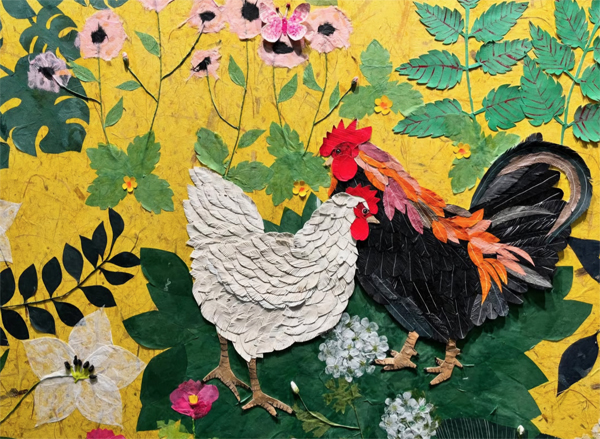
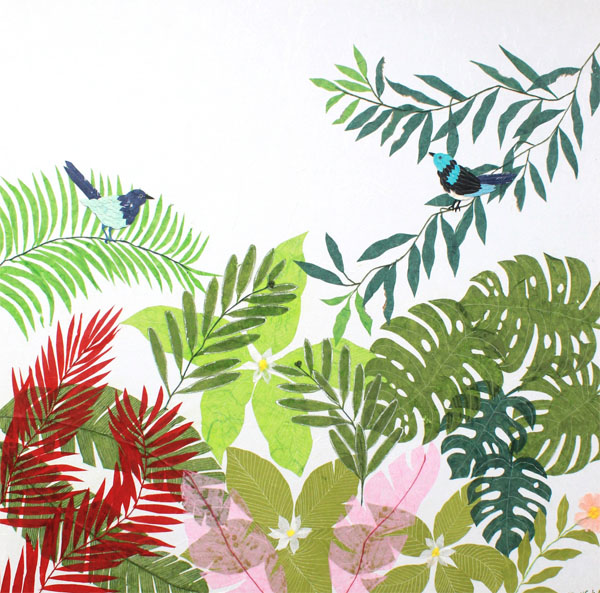
J & J Art, Inc. will present a curated collection of Jinny Suh’s latest works under the theme “Elegant Freedom: Nature, Tradition, and the Human Spirit.” The exhibition aims to create a peaceful, immersive environment that connects viewers with the emotional beauty of Korean culture, told through contemporary visual language.
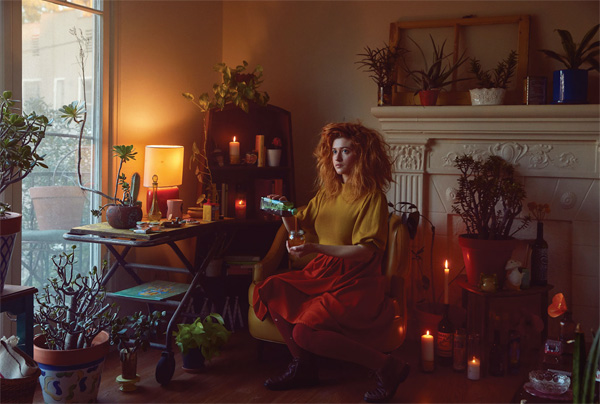
Jinny Suh’s work is rooted in nature—particularly chickens, birds, and butterflies— and uses these symbols to explore themes of freedom, elegance, and human connection. Through the use of Korean Hanji (traditional paper) and vibrant traditional Korean colors, her artwork reinterprets time-honored values for modern viewers, bringing warmth and emotional resonance to the often cold, urban spaces of today’s world.
As Jinny expresses in her own words: “At the heart of my work is Korean Hanji (traditional handmade paper) – a material with over 8,000 years of history, known for its resilience, elegance, and eco-friendliness. Remarkably, Hanji has been internationally recognized for its quality and preservation capabilities: in 2016, Italy’s prestigious National Institute of Archives and Heritage officially certified Hanji from Uiryeong, Korea, as a restoration-grade material for European cultural heritage. Since then, Hanji has been used to restore some of Italy’s most treasured artifacts, including St. Francis’ handwritten prayers and the Losano Gospel.
This is the spirit I want to bring to the LA Art Show – a celebration of Korean cultural excellence through sustainable, meaningful materials and visual storytelling. In a world increasingly impacted by war, climate crisis, displacement, and ecological destruction, I create works that reflect a longing for peace, beauty, and healing.”
Her work presents a thoughtful and poetic lens on life, inviting viewers into an experience that is both visually rich and spiritually comforting. This artistic approach has resonated deeply with collectors in both the East and West, leading to a growing international following and strong acquisition history.
Including You And Me
Presented by Gallery Wald | Booth 805
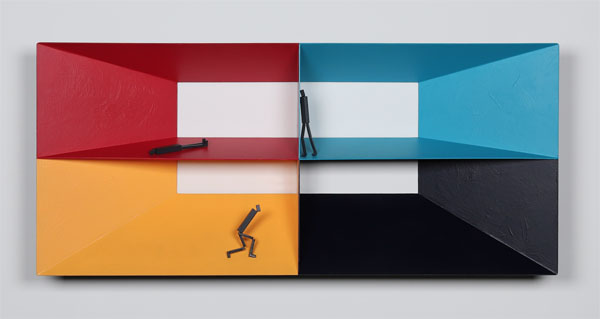
With a decade-long career that bridges traditional sculptural techniques and contemporary conceptualism, Moon Min has established himself through a distinctive series titled “나를 비롯한 그대들 (Including You and Me). His practice reflects a philosophical exploration of modern humanity in relation to technology and identity, utilizing materials such as metal, resin, and mixed media.
The “Including You and Me” series simplifies the human figure into geometric forms, portraying modern individuals confined within square frameworks. These boxed forms symbolize the structured society we live in – an architecture we’ve collectively built. Through this perspective, the artist observes and narrates the endurance and subtle resistance of those existing within these confines.
Moon Min intentionally limits expressive gestures within these frames, allowing emotion to surface not through overt facial or hand expressions, but via the faint traces found in posture – through the tension of the back or the spacing of the feet. These figures, though structurally constrained, quietly reveal their inner lives. His work is less about physical form and more about how repressed emotions are subliminally expressed – how the inner self attempts to surface from within the rigid square boundary.
Working primarily with metals like aluminum and copper, Moon renders these emotions as organic movements captured in cold, industrial material. Despite the hardness of his medium, the sculptures pulse with warmth and quiet vitality, suggesting the persistent emotional undercurrents within a heavily ordered world.
The square-shaped spaces in Moon Min’s work function as more than just structural motifs; they symbolize the framework that defines and regulates human existence and social order. Within these constructed boundaries, individuals are assigned standardized identities and drift between anonymity and individuality.
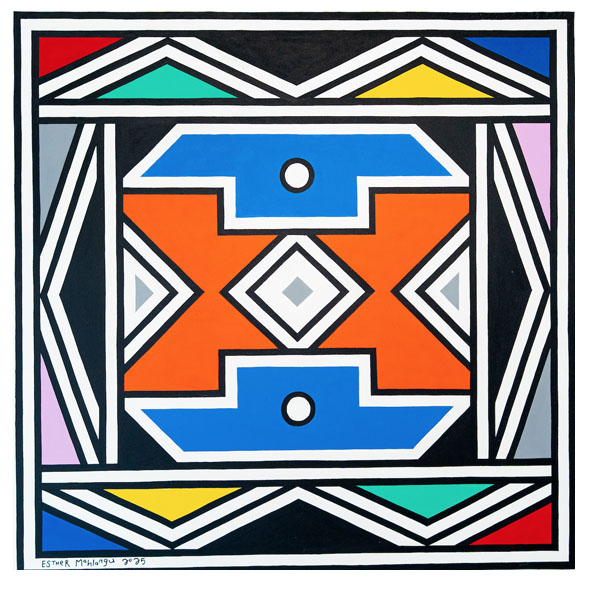
Dr. Esther Mahlangu
Presented by Art of Contemporary Africa | Booth 900
Esther Mahlangu is the globally acclaimed visual artist and much-loved cultural ambassador of the Ndebele nation. She was born in 1935 and has made a valuable contribution to contemporary art over eight decades. In 1991, Dr Mahlangu became the first woman and first African to be invited to participate in the BMW Art Car Collection. Bettina Korek, the CEO, and Hans Ulrich Obrist, the artistic director of the Serpentine recently said ‘Esther Mahlangu is one of the most important artists of her time’ when they unveiled her mural at the Serpentine in 2024.
The Melrose Gallery/Art of Contemporary Africa, Dr Mahlangu’s exclusive global representative, will present a special feature at the show. This activation includes several of her bright, abstract paintings and vessels for which she has won such global acclaim, a short video interview, and a timeline featuring some of her impressive career highlights.
Yigal Ozeri
Presented by Corridor Contemporary | Booth 506
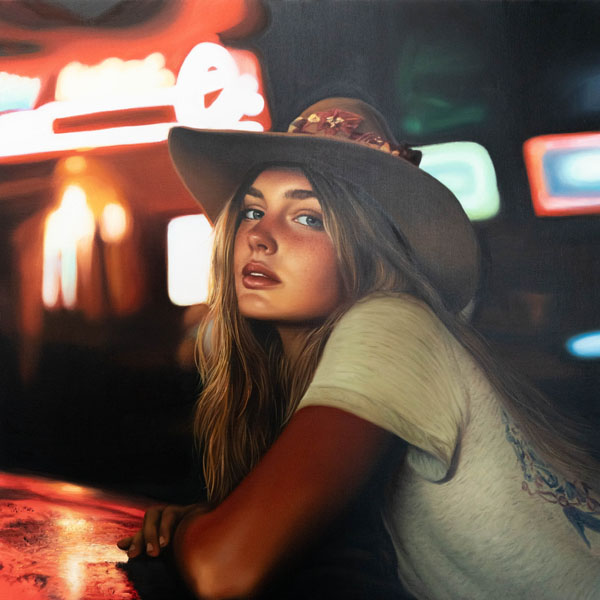
Yigal Ozeri’s solo presentation offers an intimate encounter with one of today’s most celebrated painters. Known for his hyper-realistic technique and cinematic sensibility, Ozeri captures the fleeting, often overlooked moments of everyday life with uncommon tenderness. His deep commitment to realism is not merely technical, it is emotional, rooted in a lifelong fascination with the human presence, natural light, and the quiet narratives that unfold within ordinary spaces.
Ozeri presents a selection of portraits of women situated in diverse environments: the bustling streets, the glow of diners, and the serenity of natural landscapes. These works reveal his ability to balance specificity with universality – the individuality of each sitter is rendered with extraordinary detail, yet the scenes feel both familiar and dreamlike. Alongsidethese portraits, Ozeri showcases interior scenes from classic diners, the textured charm of London streets, and sweeping vistas of nature, each painted with his signature devotion to atmosphere and mood.
Together, these works form a cohesive window into Ozeri’s world – one that blends realism with poetic observation. Whether depicting the chrome surfaces of a diner booth, the muted tones of a rainy London afternoon, or the dappled light filtering through a forest, Ozeri transforms everyday environments into luminous visual stories. His presentation offers not only a survey of his remarkable range but a reminder of the beauty embedded in the immediate, the intimate, and the real.
Paul Simonon
Presented by John Martin Gallery | Booth 508
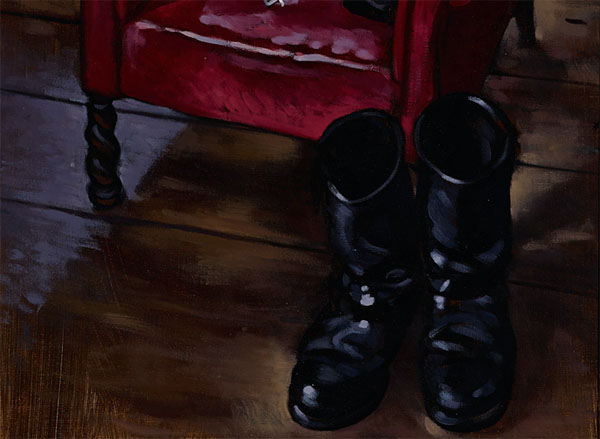
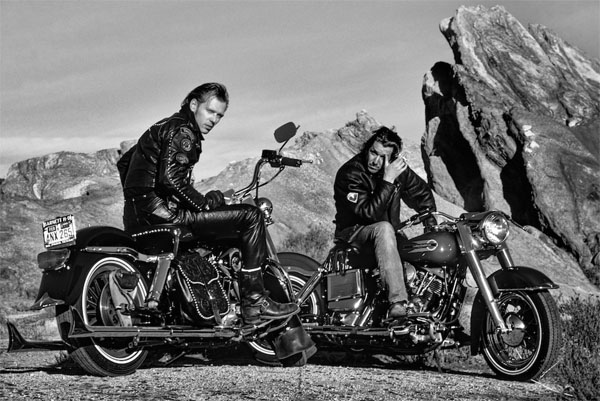
Paul Simonon: Painting and Biking in London and LA brings together five paintings that trace the artist’s lifelong connection to biker culture, from the streets of Paddington in the 1960s to his time in California in the 1980s. Painted a decade ago and drawn from Simonon’s personal collection, the works depict jackets, gloves, bikes, and helmets as quiet still lifes and reveal the profound influence biker culture has had on shaping Simonon’s artistic output, in both painting and music.
Riding through Los Angeles on old Harleys in the early 1980s, Paul Simonon became part of a loose, moving fraternity of musicians and bikes. After the break-up of The Clash, Simonon and fellow musician Nigel Dixon travelled to the United States, bought vintage Harleys in El Paso, and rode west to California. For months they cruised around LA with friends including Steve Jones of the Sex Pistols – “like a long, leather motorcycle snake,” as Simonon recalls.
The five works shown at the LA Art Show are from Simonon’s own collection and were featured in Wot No Bike, his 2014 exhibition at the Institute of Contemporary Art, London. Drawing on motifs redolent of classical memento mori, Simonon evokes personality through still lifes of jackets, gloves, bikes, cigarettes, and helmets, at rest after the ride. These works reflect a lifelong engagement with biking culture, its objects, rituals, and endurance. As Simonon says, “A leather jacket never ages.”
Steel Che (Youngkwan Choi)
Presented by Art In Dongsan
Booth 302
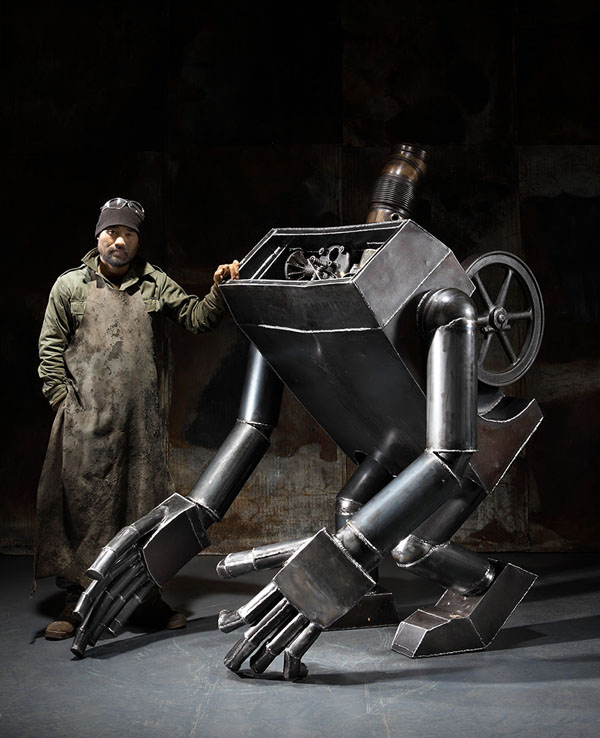
Art in Dongsan, established in 2018 with galleries in Seoul and Goyang, presents the metalwork of Steel Che (Youngkwan Choi). This exhibition highlights Che’s sculptural works, which repurpose industrial materials into artistic forms.
Youngkwan Choi, known professionally as Steel Che, has been creating metal sculptures for over three decades. His work, deeply influenced by his background in art education and his family’s connection to the steel industry, bridges the gap between traditional craftsmanship and contemporary artistic expression.
The exhibition’s centerpiece, “Steam Robot,” demonstrates Che’s mastery of steel manipulation. This large-scale sculpture, along with other works crafted from discarded metal, showcases Che’s artistic philosophy of transforming industrial materials into thought-provoking art. His diverse career, including collaborations with Harley Davidson Korea, informs his unique approach to sculpture.
Art in Dongsan’s presentation of Steel Che offers visitors a unique opportunity to experience the intersection of industrial heritage and contemporary sculpture, showcasing the evolving landscape of Korean art.
The Nature of Art
Presented by Coral Gallery
Booth 711
“A work of art encountered as a work of art is an experience, not a statement or an answer to a question. Art is not only about something; it is something. A work of art is a thing in the world, not just a text or commentary on the world.” — Susan Sontag, Against Interpretation —
The nature of art is a subject that has been debated for centuries and remains an enigma. The original split between nature and culture is the basic postulate that makes us human, but it is also what drives us to seek a connection with nature through art.
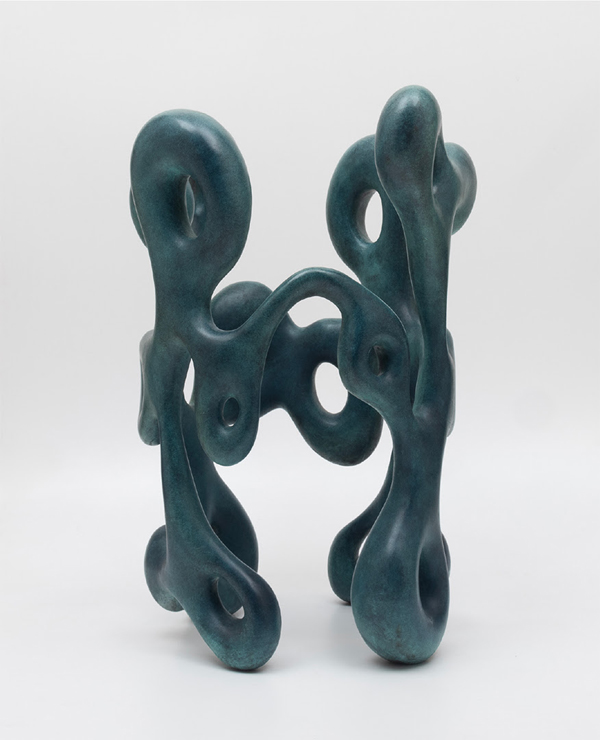
Artistic practices, like religious ones, are variations on an attempt to suture the gap between nature and culture, and Roberto Vivo’s work is an example of how art can be used to explore this relationship and find new ways of connecting with nature.
In his works, Roberto Vivo establishes a deliberate break with history, as he dispenses with references that date his view and restores forms to their primary and pristine character. In this way, he manages to reformulate the question about classical art or, better said, about what we call classical in art. That is to say, that enigmatic characteristic that transcends anchorage in an era and that continues to question where the conditions of existence that sustained the concretion and meaning of a work of art have disappeared. The action of time thus becomes superfluous in its cruel exercise of peremptory expiration over each period of life. And it forces us to think in terms of a method of interpretation that accounts for that zone of aesthetic perception that escapes the rhetorical webs of each present.
Vivo’s production evokes the boldness, and the formal and compositional freshness, of Henri Matisse’s famous cut-outs, for which the French artist cut out shapes from colored paper and arranged them on other sheets that he laid out in his studio. Characteristic of Matisse’s last creative stage, these collages composed of irregular and colorful cut-outs, similar to vegetal or floral motifs, resonate in Vivo’s works. But, in Vivo’s case, he carries them to three-dimensionality, dynamizing the forms and rendering them corporeal.
Inquiring into the essential elements that nature and art share is at the core of Vivo’s research. Form, color, volume and texture come into play in the spatiotemporal dimensions in which his works unfold. The artist appears to hide the coordinates that give rise to his designs, at times organic, at times fantastic. We observe them in a here and now, as a snapshot event that might continue to develop and grow in our absence.
In a gesture of apparent innocence, of attachment to the playful possibilities of creation, Roberto Vivo deliberately strips his works of the urgency of context, of reference and of historicity, thus offering the viewer the opportunity to approach the game of sensitive contemplation and experience without prejudice.
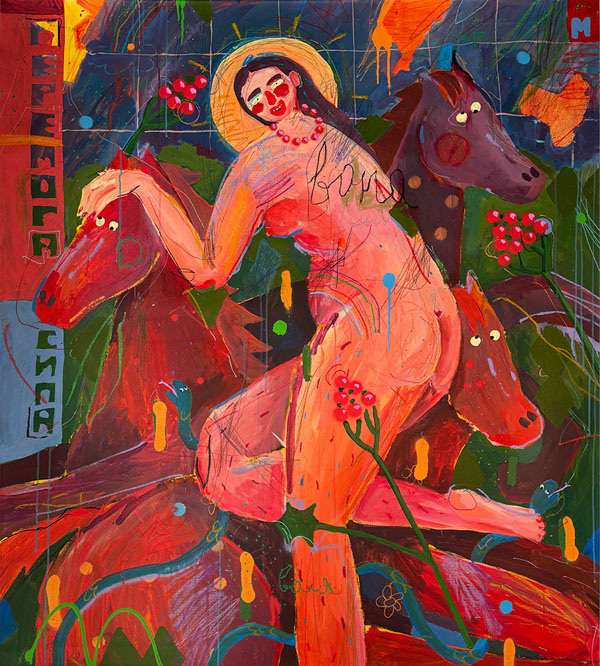
“She, Unbroken”
Presented by Snisarenko Gallery
Booth 406
Since the onset of the war in Ukraine in February 2022, Ukrainian women have endured unimaginable challenges, marked by displacement, mental health struggles, economic instability, and vulnerability to violence. Despite these profound hardships, their resilience and spirit have shone through in countless ways, not least through their art. The war has displaced millions of Ukrainian women and children, with 8 million refugees fleeing the country and an additional 6.5 million internally displaced within its borders. This upheaval has fractured communities and forced women to navigate unfamiliar landscapes while grappling with acute stress and trauma. Studies reveal staggering rates of mental health challenges, with nearly all war-displaced Ukrainians showing symptoms of Acute Stress Disorder, and 30% of the population estimated to suffer from PTSD.
The economic and social fabric of Ukrainian life has been deeply altered. With men conscripted for military service, women have stepped into traditionally male-dominated industries, such as mining and heavy labor, while also facing widespread unemployment and poverty. Meanwhile, reports of sexual violence and the harrowing conditions faced by expectant mothers—giving birth in bomb shelters and basements—paint a stark picture of resilience amid adversity.
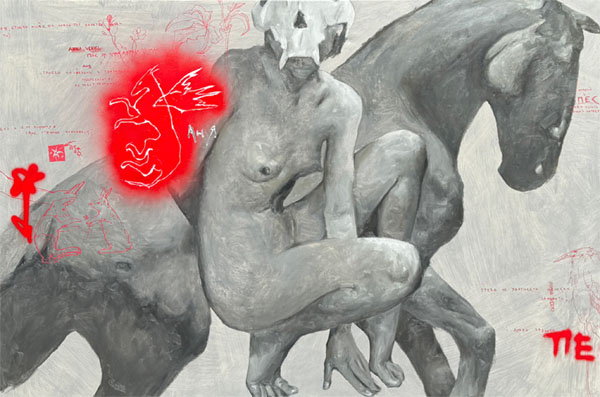
“She, Unbroken” presents the powerful and intimate voices of Ukrainian-born women artists who have endured the ravages of war and its indelible impact on identity, body, and spirit. The exhibition explores themes of displacement, reinvention, and transformation, delving into the ways conflict reshapes identity and creative expression. Each artist contributes a profound narrative, blending memory and survival in a tapestry of resilience and reinvention. This collection serves as a tribute to their unyielding strength and creativity—a testament to the enduring human spirit.
The exhibition invites viewers to reflect on the quiet strength of women navigating the aftermath of war, with works by Inna Kharchuk, Anna Veriki, Iryna Maksymova and Liza Zhdanova.
Heroes
Presented by Robert Vargas
Booth 305
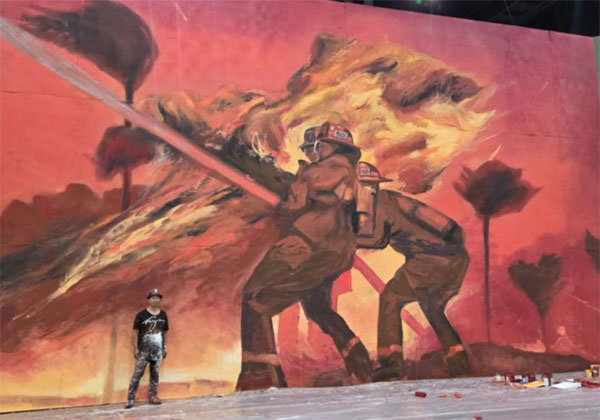
Acclaimed Los Angeles-based muralist, Robert Vargas, will be presenting a special live art experience, entitled Heroes, honoring first responders.
Known for his powerful and dynamic large-scale works, Vargas will create a massive mural onsite at this year’s LA Art Show in a heartfelt tribute to the firefighters and first responders who continue to heroically serve the city during the recent fires and challenges.
This mural, created live during the event, is an homage to the courage, resilience, and selflessness of those who protect and serve our community. The artwork will also serve as a symbol of hope and perseverance, reflecting Los Angeles’ unwavering spirit in overcoming adversity.
“Los Angeles has faced unprecedented challenges in recent times, but through it all, our community’s strength and determination have shone through. This mural will celebrate the heroes among us and honor the resilience of our city,” said Robert Vargas.
Vargas’ mural will come to life in the heart of the LA Art Show, allowing attendees the unique opportunity to witness the creative process firsthand. The work will showcase his signature bold style while capturing the essence of unity and gratitude that defines Los Angeles.
“I” of the Beholder: Dain Yoon
Presented by LP Gallery
Booth 1113/1212
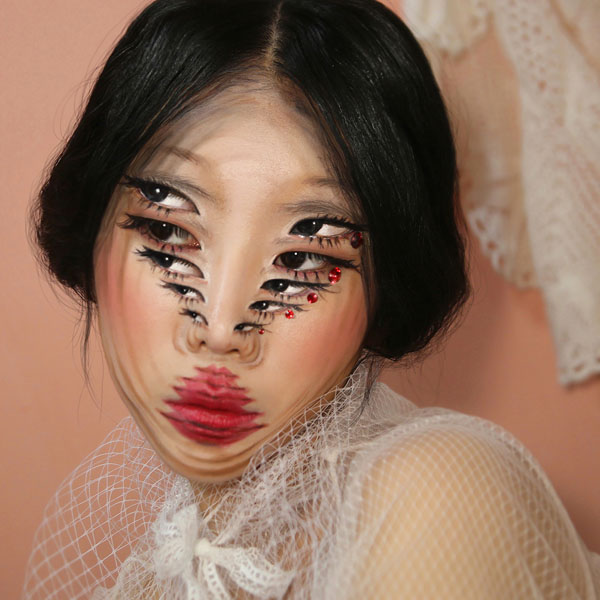
Dain Yoon is a South Korean fine artist, currently based in New York City. Widely acclaimed for her illusion painting on her face and body, and her prolific work with a variety of media, Ms. Yoon explores the complex portrayal of raw emotion filtered through the unique personal diversity of each individual. Yoon has participated in a wide variety of collaborative projects. She has collaborated with artists, including Maurizio Cattelan, Halsey, and James Blake; worked with museums including the Tate Modern and the Van Gogh Museum; and garnered significant attention in media, appearing on The Ellen Degeneres Show and in publications such as Vogue, Dazed, TOILETPAPER, and The New York Times Magazine.
Yoon views her face as the strongest and most sensitive part of her body: a canvas on which she can deliver her most delicate emotions. Her eyes in particular have always been a key object or primary focal point of her works. For this work, Ms. Yoon chose the title ““I” of the Beholder” to reflect the inherently and unavoidably unique way that each person processes both art and emotion. She used time-lapses of herself in an anxious and agitated state to capture the full spectrum of the emotions revealed through her eyes. Yoon chose large format oil paintings as the medium with the intention to evoke the same feeling of unease in the viewer. The paintings are presented without wood paneling, the same format in which they were created, to convey the raw and delicate nature of the work.
Young Masters
Presented by Cynthia Corbett Gallery
Booth 1401
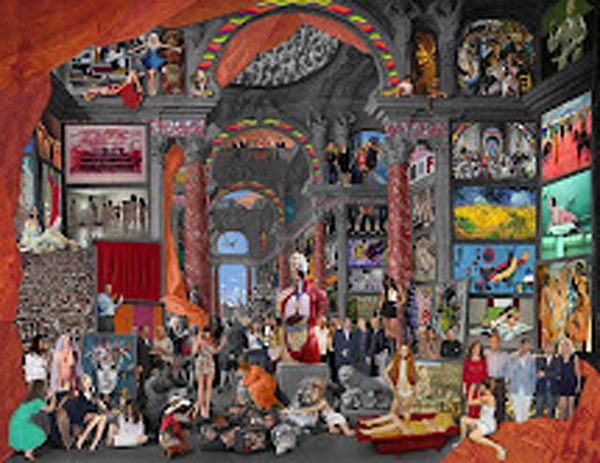
Young Masters is a not-for-profit international initiative which was launched in 2009 by gallerist Cynthia Valianti Corbett, founder of Cynthia Corbett Gallery.
Our mission is to support emerging artists from across the world, bringing their work to a wider audience through a triennial Art Prize independently judged by an illustrious panel. Young Masters has an international programme of touring exhibitions and fairs as well as maintaining a vibrant online presence that showcases our wide network.
This unique initiative highlights emerging artists of any gender, age, or nationality, working in any media, whose work responds to the art of the past.
In 2014 the Young Masters Maylis Grand Ceramic Prize was added to focus more attention on the growing interest in the collection of contemporary craft. 2017 saw the launch of the inaugural Young Masters Emerging Women Award. The fifth edition and 10th Anniversary Exhibition of the Prize took place in October 2019. In 2023 Young Masters returned after Covid-19 with its 6th edition of the Prize and its most culturally diverse and woman led open call yet with 75% of applicants being female-identifying artists.
Young Masters has provided a launching pad for over 350 artists alumni from all over the world. Important alumni include British ceramicist and curator Matt Smith, British painter Flora Yukhnovich, South-African artists Gigs Kgole and ceramicist Lucille Lewin, artist duo Ghost of a Dream and US-based Iranian Azita Moradkhani.
The Soul of Your City
Presented by Fabrik Projects Gallery
Booth 1404
Welcome to ‘The Soul of Your City’ exhibition, a unique visual journey that brings to life the diverse and intimate essences of cities from around the globe.
This exhibition is the culmination of a global photography competition organized by Fabrik Projects Gallery in Los Angeles, aimed at capturing the hidden spirit and true identity of cities and communities through the lenses of local photographers.
‘The Soul of Your City’ competition was born out of a desire to explore and reveal the unseen aspects of urban living. We invited photographers worldwide to look beyond the familiar landmarks and tourist attractions and instead focus on the aspects of city life that are often overlooked. This included capturing the subtle interplay of light and shadow in the alleys, the vibrant life in local markets, the architectural heritage in the streets, and the candid moments of everyday life.
Our call for entries resonated with photographers from various corners of the world, each bringing their unique perspective and creative approach. The resulting submissions are a rich tapestry of images that tell stories of culture, history, community, and personal experiences within urban settings.
The works showcased in this exhibition are the winners of the competition, selected for their exceptional ability to convey the ‘soul of their cities.’ These images are not just photographs — they are windows into the diverse, dynamic, and intricate tapestries of urban life. They invite viewers to go on a visual journey, traveling continents and cultures, to experience the essence of cities as seen through the eyes of their residents.
This exhibition at the LA Art Show presents these winning entries, offering attendees an opportunity to engage with and appreciate the myriad facets of urban environments. It’s an honor to bring these perspectives to such a prestigious platform, allowing the public to connect with cities’ souls through the art of photography.
We thank all the photographers who participated in the ‘Soul of Your City’ competition and congratulate the winners whose work is exhibited here. Their contributions have made this exhibition a testament to the power of photography in capturing and conveying the beauty of our world’s cities.
Visible Sound: Wish Into the Wind by Choi Sori
Presented by Art in Dongsan
Booth 1111/1210
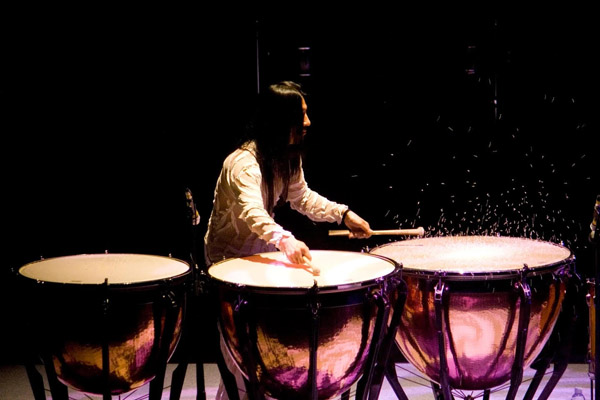
Art in Dongsan is pleased to feature a special live art performance by acclaimed artist Choi Sori. “Visible Sound: Wish Into the Wind,” is a multimedia piece that invites us to reflect on the origins of life and the majesty of nature.
Through drumming and manipulation of metal surfaces, Choi Sori creates an abstract interplay of light, color, and sound that seems to materialize the invisible energies that animate our planet. The surfaces reflect rays of light in shifting patterns depending on the movement of viewers within the space.
Sori conveys the idea that all matter and energy in the world has its own essence and message. He sees himself as a creative messenger, translating these messages into perceptual experiences that harness sound, rhythm, and the visual arts.
This performance also represents Sori’s lifelong creative philosophy of harmonious coexistence with the natural environment. Created in coordination with the seasonal changes in his native Korea over multiple years, the Wind series, Kalpa, and Fire Paintings on view alongside the performance emerge from a meditative collaboration between artist and Mother Nature.
We hope this performance and exhibition provides a mindful escape from everyday concerns, reminding us of the ephemeral beauty of the natural forces that sustain life on our precious planet.
Juan Miguel Quiñones
Presented by Pigment Gallery
Booth 813/912
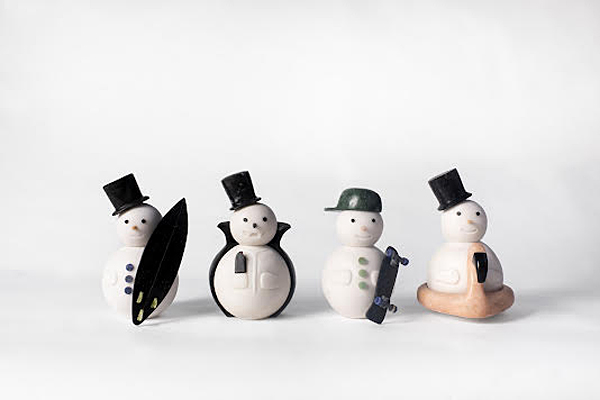
Quiñones is a self-taught artist who began in the field of restoration, an approach that helped him to understand the know-how of the old masters, learning all the traditional techniques of stone carving developed from ancient Rome to the Renaissance. An observer and connoisseur of the popular, Quiñones combines his particular sense of humor with the use of precious stones, the most refined technical skill and a profound knowledge of the materials he works with to create trompe l’oeil works that break down the barrier between the everyday object and the work of art.
The artist applies his work in stone to postmodern languages and themes, present urban languages that swing between illusion and memory and allows him to delve into antagonistic concepts such as reality, fiction, artifice or verisimilitude. Consciously, his works elude a direct or closed interpretation, forcing the viewer to project his or her own memories. Very rich in meanings, the evocative object and the material-conceptual trompe l’oeil are the most important material-conceptual. The references used go beyond the recurrent themes of urban art, hence the enormous complexity of Quiñones’ work. As iconic skateboards or surfboards represent elements detonated from evocation. The warm afternoons of southern Spain, from El Palmar to Estepona. But they are also signs of the end of pubescent innocence and the beginning of a new period, adolescence, in which human beings are reluctant to leave forever the domains of playfulness.
The World House Mural
Presented by Robert Vargas
Booth 309
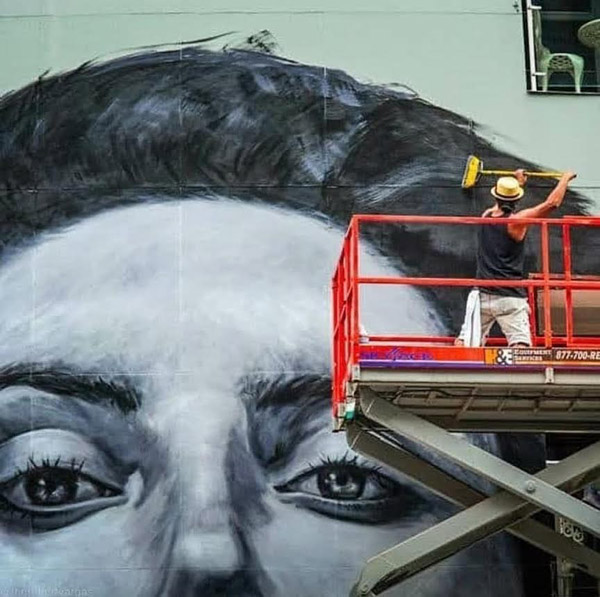
In honor of Black History Month, acclaimed artist Robert Vargas will create this mural on site inspired by one of Martin Luther King Jr.’s last books, The World House.
King imagines the world as a large house in which we must learn somehow to live with each other in peace. We are facing converging global crises – a horrific pandemic, the growing threat of world war, climate change, inequality both in the U.S. and globally, the continuing scourge of systemic racism and tensions in the U.S. brought on by elections later this year.
Vargas brings his dynamic approach to portraiture and re-imagines this inherited large house on canvas. As King writes, “A great ‘world house’ in which we have to live together — Black and white, easterner and westerner, gentile and Jew, Catholic and Protestant, Muslim and Hindu – a family unduly separated in ideas, culture and interest, who, because we can never again live apart, must learn somehow to live with each other in peace.” Robert Vargas brings necessary attention and healing through this mural in the spirit of mindfulness, and creating art for the greater good of mankind.
Evocation In Light: Philip Vaughan
Presented by bG Gallery
Booth 1303
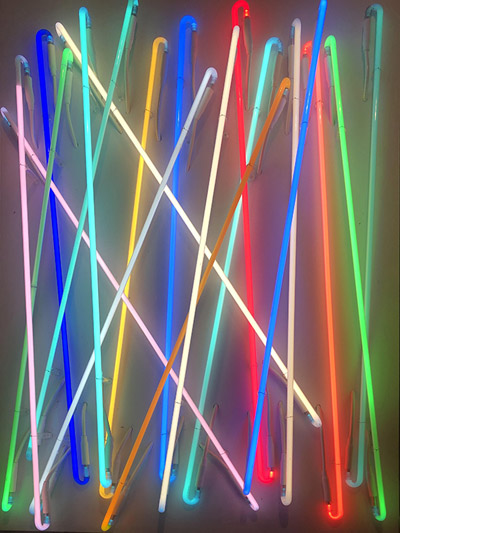
English artist Philip Vaughan first became interested in neon and light art while at Chelsea Art School in London, during a course on the theory of light and color. He was intrigued when he learned that paint mixes differently than light does, as well as by the idea of using light as a medium itself to make art. Combining this with his love of sculpture and installation, he began experimenting with all three.
While at Chelsea art school, he created a piece where three incandescent light sources spun and projected colored light on the walls, mixing the light’s colors as they spun and combined. Later he read a book by Cornwall Klein, who was experimenting with light projection and synesthesia.
Around this time, Vaughan attended a lecture given by Buckminster Fuller and shortly after that started to experiment with geodesic structures himself. He made a group of models of them and eventually started to incorporate linear lights. This work culminated in a sculpture for the Hayward Gallery on London’s Southbank, the Neon Tower whose neon lights would dim and change according to the speed and direction of the wind, reflecting its environment. After building the sculpture for the Hayward Gallery Neon Tower, he also built an 80-foot diameter hemispherical inflatable dome theater with projected light shows for entrepreneur and filmmaker John Bloomfield.
Since moving to the United States, he worked for a while at Walt Disney Imagineering where he continued to learn about lighting, theatrics, computer controls and construction. Vaughan has continued to create art and experiment with neon, sculpture, and architecture as art and technology alike evolve. He continues to plan and build public sculptures, using light and other media.
Donde Voy: Jin Hyu Lee
Presented by J & J Art, Inc.
Booth 401
English artist Philip Vaughan first became interested in neon and light art while at Chelsea Art School in London, during a course on the theory of light and color. He was intrigued when he learned that paint mixes differently than light does, as well as by the idea of using light as a medium itself to make art. Combining this with his love of sculpture and installation, he began experimenting with all three.
While at Chelsea art school, he created a piece where three incandescent light sources spun and projected colored light on the walls, mixing the light’s colors as they spun and combined. Later he read a book by Cornwall Klein, who was experimenting with light projection and synesthesia.
Around this time, Vaughan attended a lecture given by Buckminster Fuller and shortly after that started to experiment with geodesic structures himself. He made a group of models of them and eventually started to incorporate linear lights. This work culminated in a sculpture for the Hayward Gallery on London’s Southbank, the Neon Tower whose neon lights would dim and change according to the speed and direction of the wind, reflecting its environment. After building the sculpture for the Hayward Gallery Neon Tower, he also built an 80-foot diameter hemispherical inflatable dome theater with projected light shows for entrepreneur and filmmaker John Bloomfield.
Since moving to the United States, he worked for a while at Walt Disney Imagineering where he continued to learn about lighting, theatrics, computer controls and construction. Vaughan has continued to create art and experiment with neon, sculpture, and architecture as art and technology alike evolve. He continues to plan and build public sculptures, using light and other media.
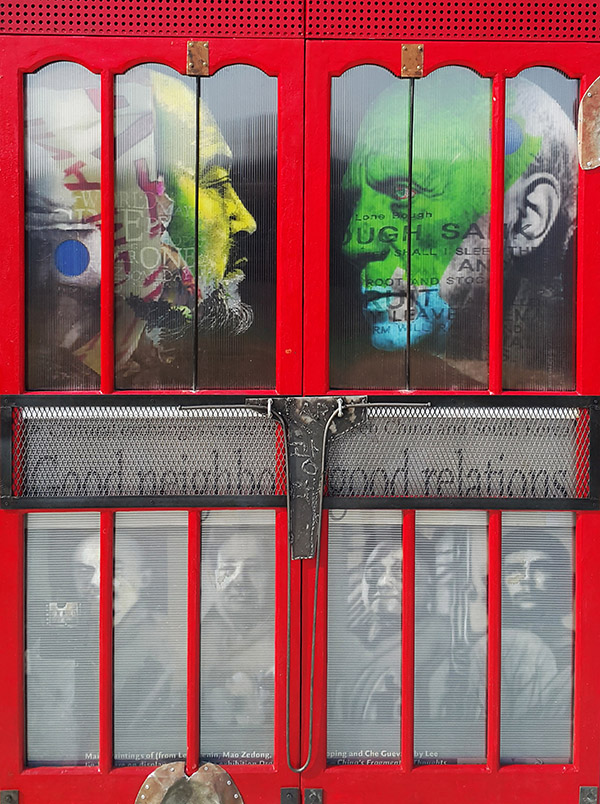
The artist is focused on how to express the objects that he sees, interpreted with different perspectives, by trying to recreate the meaning of the things scattered around him. Jin Hyu Lee enjoys experimenting, using different methods, such as splitting the space in canvas, attempting to escape from the ordinary views, searching for new dimensions of objects around him.
His works are blended sentiment derived from the mixture of conventional painting and digitized culture that has become the fact of life, with historical and ethnic traces. He finds a new way of painting, which is based on the classical way of thought.
Launch Intention: Griffin Loop
Presented by Fabrik Projects
Show Entrance
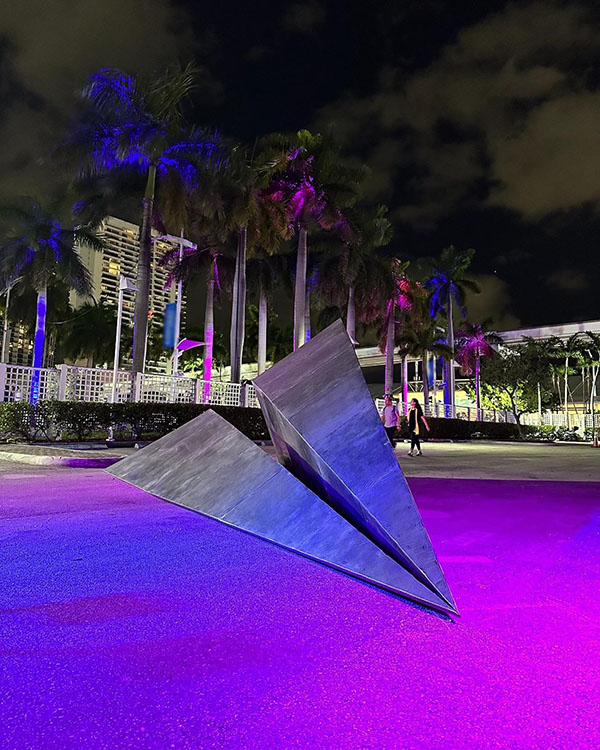
Griffin Loop is a sculpture artist who creates large scale installations that have been commissioned and collected in both private and public settings across the United States. Griffin uses his platform as an artist to engage communities and youth.
“Launch Intention” is based around the symbol of a paper airplane and is used to support individuals and groups in the act of setting intention, sharing with the greater collective and launching into action. The artist has installed and programmed large scale “paper” airplanes in communities and schools across the United States.
A paper airplane represents youthful innocence and fun. It is one of the first things we create as children and launch into the world. The launch intention project based around this childhood symbol takes us back to that carefree imagination and freedom. It stands for tapping into the intuitive self and truth we all have. Embracing the dreams and path we are ultimately supposed to take. A platform to solidify these dreams and share with each other and the world. A symbol for optimism and hope. Self. Community. Support. Vulnerability and accountability. Launch Intention is a reminder for all to free yourself. Set intention and launch into action and the world.
Searching In No Man’s Land: Julio Vaquero
Presented by Pigment Gallery
Booth 1021
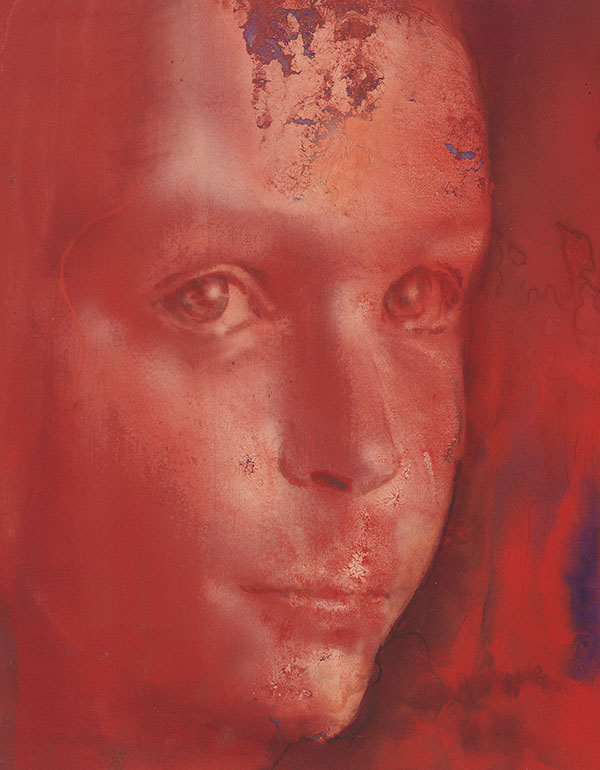
Julio Vaquero (Barcelona 1958) has developed his work as a painter around the world of culture, knowledge and his confrontation with the experience of time.
His large-format paintings and installations have been shown in different exhibitions on realism, such as “Realism in Catalonia”, Barcelona 2000; “Mimesis et inventio”, Panorama Museum, Bad Frankenhausen, Germany 2002; “Visions of Reality”, Caja Canarias Foundation, Tenerife Spain 2014.
Also in 2014, Vaquero presented his work “The End of Appearances” at the “Centre d’Art Santa Mónica” in Barcelona, a large installation created with solidified paint that confronted the experience of contemplating the past and the horror of time.
His latest personal exhibitions at the Marlborough Gallery in Barcelona and Madrid have shown his drawings on tracing paper in large format, where Vaquero works with materials created by himself, looking back at the history of painting “Stolen Museum” Barcelona 2018 and on the ambiguity of the realistic representation “Memories of the Physical World”; Madrid 2020.
On this occasion, Vaquero presents his latest gouaches in small format on the ambiguity of the idea of identity, creating digitally manipulated faces whose changing and brittle material quality seems to evoke the feeling of fragility of our existence.
Raintype: Lorenzo Marini
Presented by Bruce Lurie Gallery
Booth 1013/1112
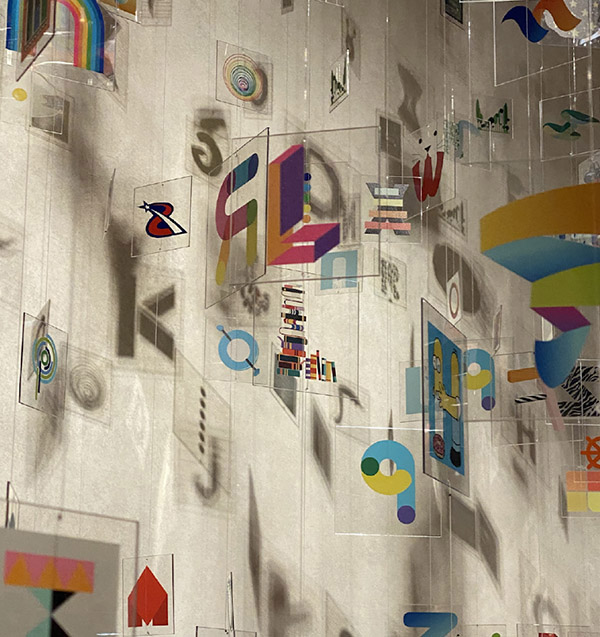
This immersive installation, by Lorenzo Marini, is inspired by a rainy day. Only here the drops of rain never fall, but remain suspended in a linguistic universe waiting to be discovered. Letters only become such when joined with other letters and take the form of the word. They acquire meaning in their linear composition. In this work of art, the letters never touch land, but remain in the world of ideas, of the possible, of the potential. They are in no hurry to touch the ground, they are in no hurry to become a word, a sentence, a discourse. They love the freedom of space and the suspension of time. They aspire to become fragments of eternity.
Wings Of Grace: Wonsook Kim
Presented by Gallery Elim
Booth 402
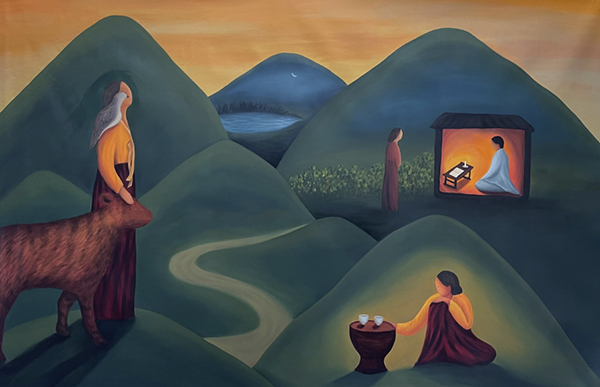
Wonsook is both a painter of magical, vivid landscapes, and a storyteller of the universality of human hardships. Her flowing images refuse to yield to eye-catching trends and instead engage her viewers through heartfelt stories.
Her quality lies in her strong personal style that carries both the pureness of a child’s touch and the expert craftsmanship of an experienced artist and colorist. Wonsook’s work instructs us to appreciate the joys of life and to persist in the face of difficulties.
Drawing from experiences as a Korean immigrant and embracing an introspective attitude, Wonsook has created a visual diary of her life that many people, regardless of their identities, can not only be immersed in but also relate to.
Awarded for the 50th anniversary of the United Nations, her work was made into stamps and contributed to the transformation of the University of Illinois into Kim Won-sook University. Her work is Magical Realism. Through her work, she represents Korean sensibility and presents us with an artistic fantasy that we must not lose.
W.T.C: Concrete Abstract I Shai Kremer
Presented by Art Bond
Booth 399
For younger Americans born after the attacks, 9/11 is not a memory lived, but history learned. Twenty years later, we remember those who were killed, as we honor the service and sacrifice of the brave first responders who ran toward danger to save others. By showing this body of work, we want to encourage reflection and help ensure that a new generation learns how, together, we met unimaginable tragedy and unfathomable loss with hope, resilience, and unity.
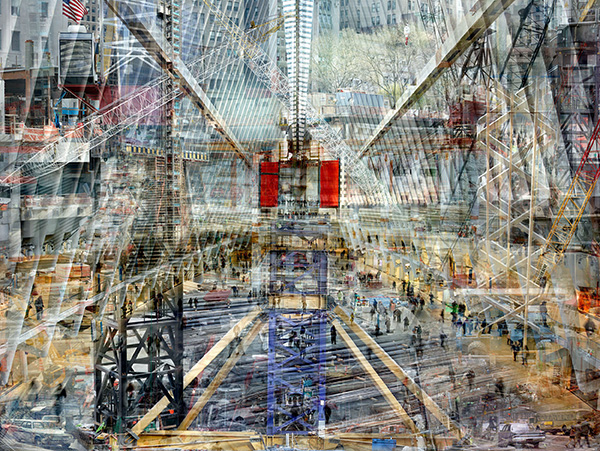
An evocation of site, a remembrance of tragedy, a progression towards healing – Shai Kremer’s Concrete Abstract series at once aims for individual and universal response to the destruction and rebuilding of the World Trade Towers following September 11th, 2001. Kremer describes his Concrete Abstract series as a means to “pay homage to America, to New York, to their trauma and their recovery.” The artist evokes the renovations and rebuilding of a once devastated sight as representative of a fresh start and ongoing therapeutic process for New York City.
Like his past series, Kremer maintains “a post-traumatic gaze to the cityscape of Manhattan – and by extrapolation, to the sociological landscape of America.”
Kremer combined copious images to illustrate the site’s former self as well as its years of reconstruction. In the most recent works *The Tribute in Light*, a memorial installation of 88 searchlights forming two columns of light in place of the towers, brings new life to the hopeful images. The strength of the façade of the Freedom Tower is a testament to how far we have come in the rebuilding process. Kremer records a compelling interpretation, in which a process linking “accumulation, destruction, and reconstruction” become “the paradigm of modernity.” The zenith of that modernity, the now tallest building in the United States, is a proud symbol of our strength.
As an Israeli, Kremer has always been invested in the political tensions in Israel – an awareness that has left an indelible stamp in his artistic production. Born in Israel but living in New York for decades, he received his MFA from the School of Visual Arts. His work has been exhibited widely, including Blue Sky Gallery, Portland, Houston Center for Photography, the Israel Museum, The Tate Modern, the Walker Art Center and many others.
Kremer’s work is in numerous public collections including The Metropolitan Museum of Art, Museum of Fine Arts, Houston, the San Francisco Museum of Modern Art, the Tel Aviv Museum of Art, Bowdoin College, the Schwartz Art Collection at the Harvard School of Business and the Rose Museum at Brandeis University.
Excerpts from a text by Gigliola Foschi – Curator
“In Kremer’s images, different points of view gather and amalgamate, fold in layers, repetitions of past and future intertwine. Imbued with time and memories, the works of the series Concrete Abstract are the result of a long process of work, born with the documentation of the reconstruction of the World Trade Center’s site, where the Twin Towers collapsed tragically in September 2001. Each image, in fact, contains over 60 overlapped photos, which were taken by the author over time and combined, day after day, preserving the overall power of details. Thanks to this operation – where the durability and the strength of memory stand against the mere flow of events destined to oblivion – his works look like a restless device, stretched between centrifugal and centripetal impulses, between chaos and order, between fragmentation and structuring of space. Like nets, like an invisible suspended maze, his images may remind us of “pictorial dynamism” and the dynamic tension which is typical of the Futurists. With Kremer, however, the vitality and the polyphonic simultaneity, found in the works of the Futurists, turn into an impersonal machine, which is powerful, dramatic and lacking univocal directions at the very same time.
The city does not grow towards a bright future anymore (like in the famous work by Umberto Boccioni), but struggles through destruction, accumulation and continuous reconstruction. After having investigated the debris and the ruins, both ancient and contemporary, which painfully mark the Israeli landscape (like in his previous work Fallen Empires and Infected Landscape), Kremer creates, with Concrete Abstract, images, which become gloomy and disturbing metaphors of modernity. Based on shared presence and interferences, on correspondences, on multiple meanings, his works fight against the logic of fundamentalism from inside, since it is based on a sole truth, on a purity lacking any mix up, on a rigid and indisputable division between right and wrong, true and false. Reality is not univocal – as we are reminded through the works of Kremer – but it is an intertwining of many different truths and points of view.”
Installation: Personal Artifacts I Alexandra Dillon
Presented by bG Gallery
Booth 1216
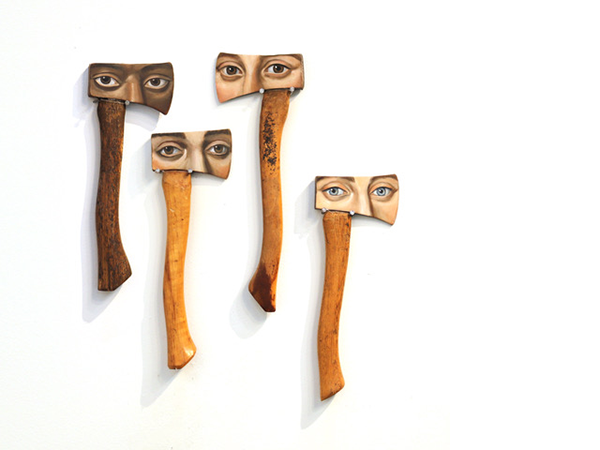
In this project, artist Alexandra Dillon explores character, personality and emotion by painting imagined portraits on used tools and other implements – recycled from swap meets and flea markets.
Tools such as axes and cleavers, hint at hidden and repressed feelings of rage and revenge, while her tiny lock and key sculptures offer hope that each of us can find the solution to our personal struggles.
Her old master style faces on coal shovels, cleverly employ the ruffled base as an Elizabethan collar, and circular saw blades carry similar faces of strong women – badass babes whose time has come.
Her installation piece “Mood Swings” is a kinetic sculpture on two large shovels that are balanced on a mount that allows the viewer to manually move them revealing a face that changes from a smile to a frown as it swings on its axis.
Nature of Providence I Séverin Guelpa
Curated by Laura Ayala; Marisa Caichiolo
Presented by Building Bridges Art Exchange
Booth 1300
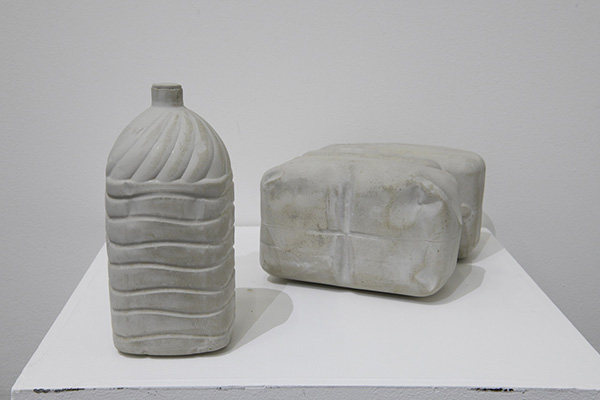
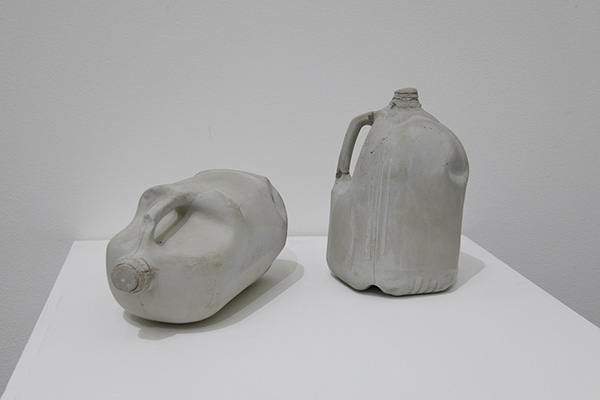
Building Bridges Art Exhcnage’s Artist in Residence Program provides artists’ with a unique challenge by offering them the opportunity to create, in record time, a site specific body of work which requires a full time commitment. The program is an invitation for experimentation and research, which is carried out with curatorial accompaniment that supports the artist’s concepts, and provides different ways of exploring their own work.
For this year’s residency, artist Séverin Guelpa worked in a wide range of mediums: installations, objects, sounds, and photography, while exploring ideas of documentation, gathering, and analyzing life in the desert, an area he has worked in since 2014. This exhibition is the result of the artist’s exploration during the residency period, and deals with an unnamed phantom, a specter that haunts or perhaps shines a ghostly light onto the inner soul behind “the desert”. This mirage confuses and fascinates him; but despite this, he decides to explore the physical and emotional territory. Throughout the residency, Guelpa plunged into the wild, untamed landscape of the desert, the boulders, the iconic Joshua trees, and the vast terrain opening onto the Milky Way above. As a conceptual artist, Guelpa focused on a survey of the territory, its geography, and the underlying tensions and fragility of living systems in the desert.
The high desert has long been a refuge for intrepid creative characters and stories. It’s a place that attracts dreamers, undeterred by the inhospitable environment. Séverin Guelpa’s artistic proposal gives us the opportunity to access multiple layers of interpretation but, above all, to see the effects on people who decide to experience the desert’s apparent emptiness. With this exhibition, Guelpa connects the undeniable and surreal vistas of freestanding home structures with the relationship between the land, nature’s resources, and private property. He gives new meaning to the debris that has been cleansed by the desert, and brings new possibilities of composition that explores the forces of balance in chaos.
Shining Light in the Darkness
Aging Out: A Community Project I J.P. Gonçalves
Presented by Connect Contemporary
Booth 408
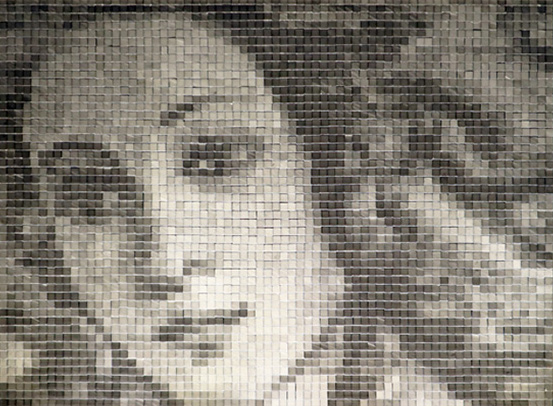
Aging Out seeks to visually capture the reality of a social injustice that, too often, lies hidden in the shadows. Viewers are invited to consider seven portraits — each portraying someone who, upon turning eighteen years old, has either “aged out” of foster care or would be “aging out” if a family had not gotten involved.
Each portrait is made of 3,000 squares. Each square is uniquely placed and angled either towards or away from the light source. The image created is only made of reflected light or shadows cast. In total, the 21,000 squares represent the amount of youth who age out of the American foster care system each year. Every eighteen seconds, the central light source is extinguished, revealing the face of a youth who’s endured a journey in this system, along with a poignant statistic illuminated by a smaller light. This cyclical lighting and extinguishing temporally represents the dreaded moment where, upon turning eighteen years old, our nation’s most vulnerable young adults are abandoned by the state and rendered subject to the mercy of the unjust societal forces that create these sobering statistics.
J.P. Gonçalves’ distinct technique uses shadow and light to expose the image, the message, and ultimately, a social inequity that deserves a well-defined place in the minds of compassionate and justice-oriented people with a heart for leveling the playing field so that all young people, regardless of their origins, have a fair chance at creating a meaningful life for themselves.
Born in 1979 in Rio de Janeiro, multimedia artist J.P. Gonçalves moved to the United States at the dawn of the new millennium. He attended school for architecture at Universidade Santa Úrsula in Brazil and later took courses in Industrial Design at the Art Institute of Fort Lauderdale.
He now works at his studio in Greeneville, Tennessee, and his work is collected across the US and internationally, including Ripley’s Believe It or Not Odditorium. In 2016, Gonçalves was awarded First Place in the two-dimensional category by public vote at ArtPrize, an international art competition headquartered in Grand Rapids, Michigan. In 2021, the artist furthered his ArtPrize legacy by earning the 2D Juried Award with his most recent exhibition Aging Out / 18 Years Old.
In his interpretations of the works of artists like da Vinci, Michelangelo and Bouguereau, the artist exposes that a clear expression of beauty, non-conceptual and free from abstraction is as important as the search for beauty in impressionism, abstraction, and conceptual art. Beauty can be simultaneously clear and hidden. Denying the pure expression of beauty requiring no explanation or examination is a sad injustice to humanity, in the same way it would be unfair to limit the artist’s freedom to search and conquer beauty in chaos or in conceptual ways. Gonçalves investigates the possibilities of beauty from the minimalistic arrangement of seemingly unrelated fragments to a complex well-planned and elaborate arrangement of precisely trimmed media, reflecting light with perfection to achieve an image that resonates with the human soul through undeniable and unanimous standards of beauty.
Memory of a Space
An Immersive Experience
Photography I Jessie Chaney
Exhibition Design I Chris Davies
Presented by Fabrik Projects
Booth 1025/1124
Jessie Chaney’s ongoing series Memory of a Space brings into focus numerous forlorn and overlooked sites the artist has encountered in her travels. These abandoned spaces are remnants of progress and change, empty buildings which provide evidence of previous inhabitants. Whether changes of fortune or the construction of new nearby highway leaves such places cut off and ultimately deserted, they still hold many telltale pointers to the lives and loves that once filled them.
Chaney finds beauty within the ruins and detritus that society leaves behind. Rather than mourn what has been lost, she celebrates the little details that provide glimpses into the past. This immersive installation both houses and echoes her artworks. Glimpses of other artworks appear as one navigates the space, and scrims provide veiled views though grimy windows, like those the artist encounters when peering into long-overlooked rooms. While Chaney’s photographs are essentially devoid of people, they still evoke an aura of humanity. The images tell stories through what has been left behind, fallen into ruin and often subsequently unofficially re-adorned with contemporary imagery. If her imagery conveys an air of nostalgia, it is not intended to be facile. Memory of a Space draws attention to the rapid changes in modern life, while celebrating small mementos of civilization.
Chaney began this body of work in earnest before the term ‘COVID-19’ was coined. Since then, as the global pandemic has continued, the series has assumed an additional gravitas, not influenced by prevailing political views or conspiracy theories. Focusing on the impact of societal change, Chaney’s abandoned spaces now might be seen as possible safe havens for the future.

Conceptual Traditions
Presented by Jane Kahan Gallery
Booth 398
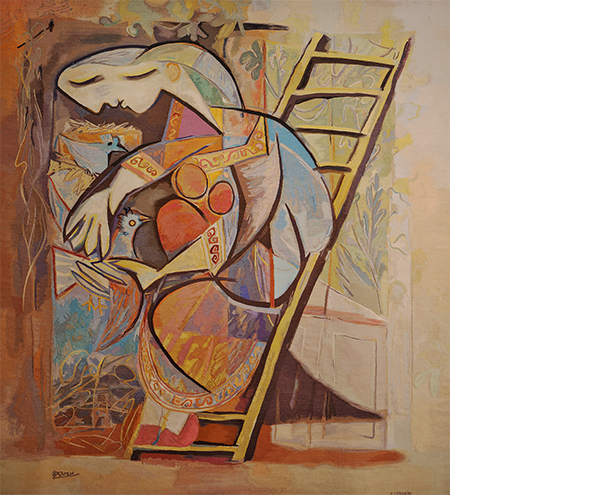
Jane Kahan Gallery is pleased to present Conceptual Traditions, featuring a selection of artworks from its collection of 20th century art by Pablo Picasso, Marc Chagall, and Alexander Calder.
This exhibition brings together five works that highlight the collaborative process of creating art in specialized mediums such as tapestry, printmaking, and ceramic.
Known for creating powerful images inspired by the beauty of the natural world, these artists often shared their artistic drives with artisan workshops that guided their visions to realize large-scale concepts.
With methods and materials sourced directly from the earth, the featured works give viewers a chance to observe stylistic similarities and technical skill across mediums.
Flying in Spatial Atmosphere I Carlo Maria Mariani
Presented by Pan American Art Projects
Booth 404
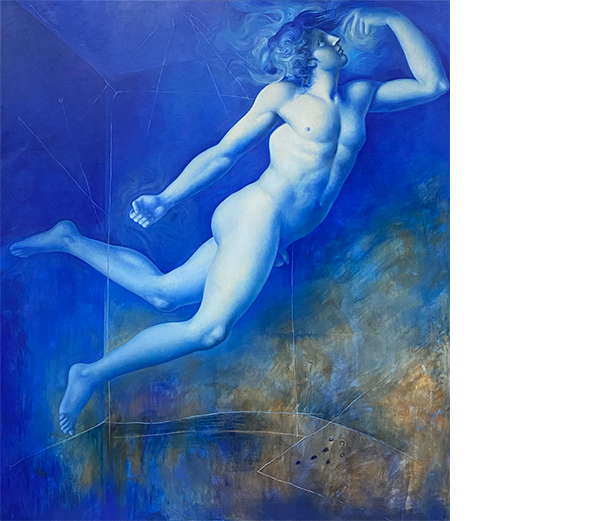
There is a strange lucidity to Carlo Maria Mariani’s paintings, a beauty and radiance of surface and figure that seems more than the sum of their art historical parts.
Mariani is a surrealist: his art is a kind of argument. All of his pictures involve a manipulation of symbols of ideality, presented with sensuous perfection, which gives them an ideality beyond reproach – in a sense beyond interpretation. Mariani‘s painting is thus a celebration of the ideal in art – the seemingly perfect – wherever it occurs. He isolates instances in which it appears.” This is the excerpt from Donald Kuspit in the 1990 Biennale di Venezia catalog about the artist.
The present painting Flying in Spatial Atmosphere, 1989 is an autobiographical leap into space based on Yves Klein’s Leap into the Void (1960), and thus rendered in Klein’s famous blue.
Where the Streets Have No Name
Presented by Arushi Arts
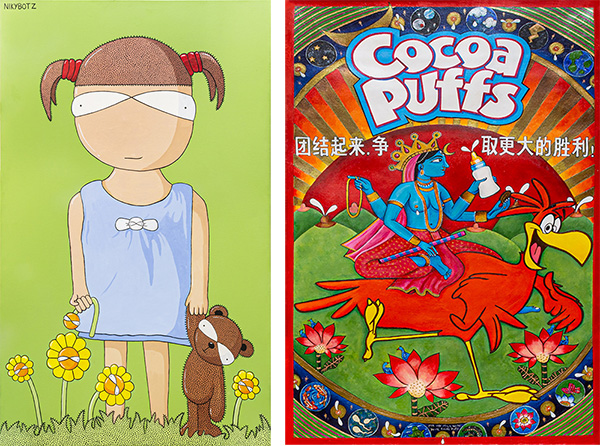
Arushi Arts presents ‘Where the Streets Have No Name,’ a collection of works by emerging pop street artists from different parts of the world.
The collection showcases artwork by Riya Chandiramani, an Indian Artist from Hong Kong; a grid of small metal street signs by Los Angeles artist, Sellout; a Ceramic Skateboard Sculpture by Miami sculptor Jenna Helfman; work by British pop artist Marty Thorton; contemporary street artist, Roger James, from Los Angeles; and emerging British artist George Weait. Through generations, artists have been inspired by their milieu and these artworks illustrate a dialogue between the artists and their respective environments.
Juxtaposed against intricate South East Asian artwork, the artworks are displayed next to each other to give the viewer a sense of the unique nature of techniques used while sharing the notion of ‘their streets’ as the crux.
Iconoclasts: Kilduff’s Saloon, est. 2021 I John Kilduff
Presented by bG Gallery
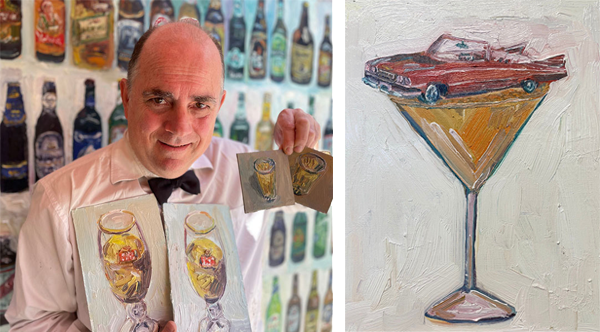
Los Angeles-based artist John Kilduff has created an interactive installation at the fair built from paintings and cardboard sculptures to look like a neighborhood bar establishment. Attendees will have the opportunity to step into the immersive installation and order ‘drinks’ hand-painted by the artist. Kilduff will create new paintings of cocktails and specialty drinks daily. Participants will have the opportunity to order what is on tap or, when the artist is in, order custom drinks off-menu. A portion of the proceeds will go to supporting bar and venue workers who are experiencing financial hardships due to the pandemic.
Based in Los Angeles John Kilduff, aka Mr Let’s Paint, is known for his daring performance art and his television show, Let’s Paint TV. Through his show and work, Kilduff pushes his painting endurance through a series of multitasking and painting challenges to encourage audiences to embrace creativity and self-expression through life’s obstacles.
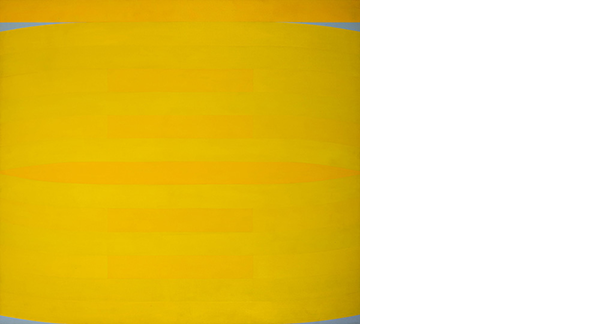
Color Fields I Michael Loew
Presented by Daphne Alazraki Fine Art
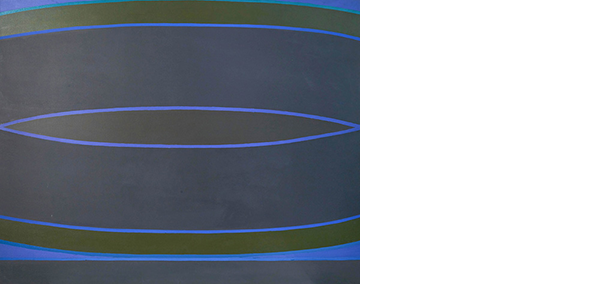
In the late 1920s Michael Loew was enrolled at the Art Student’s League and later was in France where he studied with Fernand Leger. Loew was close and longtime friends with Willem de Kooning who influenced his work.
After Pearl Harbor, Loew joined the Navy and served as the battalion artist for the “Seabees” in the Pacific. His watercolors were drawn largely from his Navy work on Tinian Island. When he returned home in 1946, his painting moved quickly toward Abstraction.
It was the 1950s that brought the full development of his mature style. He studied with Hans Hoffman and cultivated his sensibility for color effects. He used the grid-structure of Piet Mondrian as a base to experiment with possibilities of palette and to focus on the subtle transitions of tone or harmony of color relationships. He changed subjects into unique patterns of rectangles or color. As a major proponent of Abstract Expressionism and later Color Field painting, Loew produced many colorful examples, such as Blue Edge and Yellow on Yellow.
Over the course of his life, Loew’s work was exhibited extensively in galleries and museums including: The Guggenheim and The Whitney in NY, the Dallas Museum of Art and The Philadelphia Museum of Art.
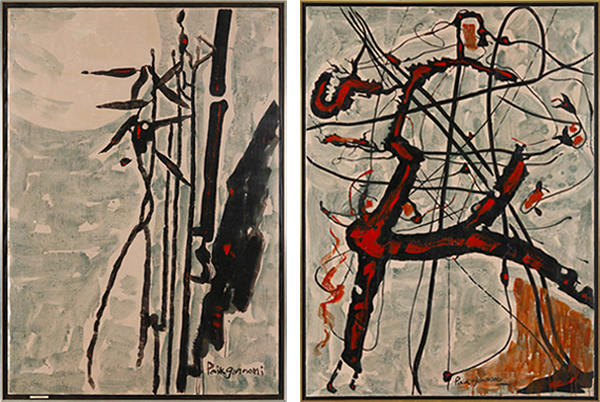
Abstract in Nature I Paik Gannomi
Presented by JJ Art, Inc. Los Angeles
Korean-American abstract painter Paik Gannomi in his terse five flowing strokes produced Sonaggi (Rainstorm) in 1973, New York. Abstaining from being elaborate or superfluous in expressing a natural phenomenon, Rainstorm, he stated through bare minimum of lines and colors. In his use of line, he shares commonality with the Korean form of calligraphy art Seoye, in which a force of stroke must come alive with an inherent movement and rhythm. Artist Gannomi’s strokes add profound dynamism by characteristic embodiment of deep red within black. Ensuing space created by the lines is another trademark of his works influenced from Korean traditional art.
His art can be categorized as an abstract expressionism in line with Franz Klein and Jackson Pollack. Most of Paik Gannomi’s work was not consciously created with a title in mind, rather a perfunctory impression emerged from the lines and spaces.
While his contemporaries back in Korea found fascination with the monochrome movement in 1970’s, he held his own forte with the unique style of aquamarine background overlayed with the flowing red on black lines. The epitome of his works came to fruition when he was awarded the Prix d’Audonne for “Paysage de Seine” at Grand Palais, Paris 1981. Previously, in 1980, he received the Mayor’s award at Palais Vincennes, Paris for “l’Automne” and “Sainte Face.”
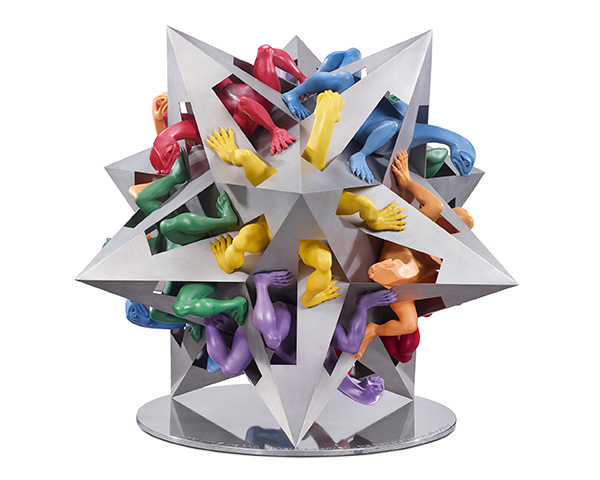
Gravity I Andreas von Zadora-Gerlof
Presented by M.S. Rau
Zadora-Gerlof pays homage to M.C. Escher in this mind-boggling work of stainless steel. The piece was inspired by the Dutch artist’s 1952 Gravitation, which explored the impossibility of multiple sources of gravity working together on a single object. Escher manifested this theory through twelve turtles who use the star as a common shell. Represented in six colored pairs – red, orange, yellow, purple, green and blue – each turtle rests directly opposite its counterpart.
Though Escher’s creation is a physical impossibility, he presented it in a visually credible and logical way. Zadora makes the genius of Escher’s creation a reality through precisely cut pieces of stainless steel and polymer. At first glance, it appears to be a nonsensical jumble of turtle heads and limbs, though a closer inspection reveals the inherent symmetry and harmony of the design.
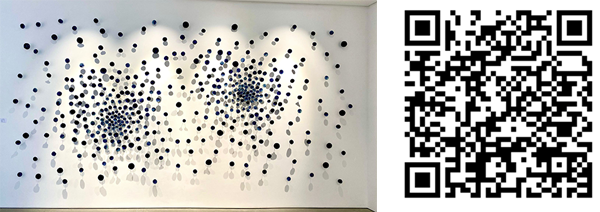
“The Butterfly Cry”
Artwork I Eduardo Pérez-Cabrero
Soundwork I Clàudia Vives-Fierro
Presented by Pigment Gallery, Barcelona, Spain
This installation, created from 490 ceramic petals, is inspired by the fact that butterflies have seen their habitat really reduced in an alarming way during the kingdom of the human being. Please feel free to get your cell phone close to the QR code and be ready to listen to the “butterfly cry”, when these beautiful creatures demand their turn to rule the world, to bring the benefit of balance and wellness for all the beings on our planet.
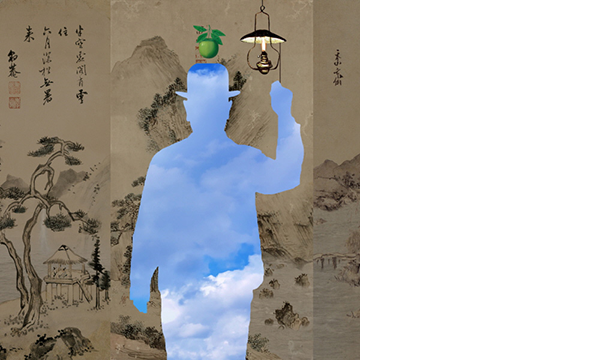
Cartoon-Digital Panel Folding Screen: Imagined Borders I Lee Lee Nam
2018, LED TV x 5, 11min 14 sec
Presented by Simyo Gallery
Lee Lee Nam (b.1969) creates amalgamations of today’s high-tech environment and traditional culture.
With exceptional finesse, he creates mesmerising digital and video works that juxtapose European old master paintings and traditional Asian art with modern day imagery. The artworks are overlaid and interwoven like a palimpsest, creating an image as fictitious as dreams overlapping reality.
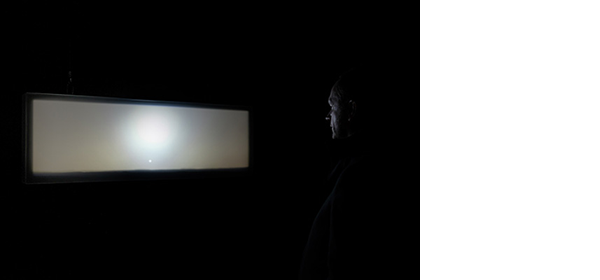
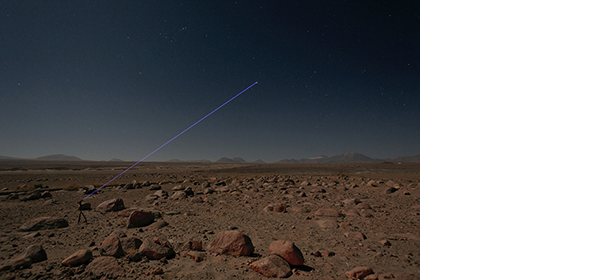
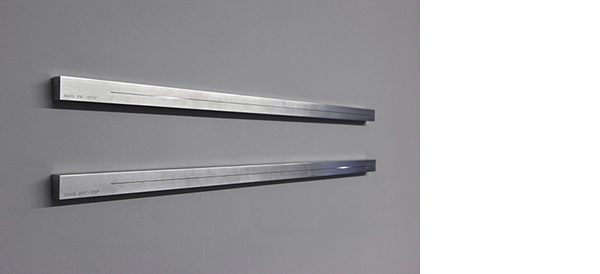
Liminal: Martian Sun I Félicie d’Estienne d’Orves
Presented by The Spaceless Gallery
Mixing light, sculpture and new technologies, the work of Félicie d’Estienne d’Orves questions the process of vision and deconstructs our gaze.
Her installations use a phenomenological approach to reality, they underscore the perception of time as a continuum. From audiovisual performance to land art, her research has focused on astrophysical space and natural light cycles. The visual artist works with outerspace landscapes through a ‘tele-vision’ process, where depth of field is being augmented by telescopes, rovers and astrophysical modelling.
Liminal: Martian Sun is a show that we decided to construct around the focused oeuvre of works by Félicie that intersects through different dimensions, time and space. Hovering between opposites, the artist’s works challenge the places of intervals like life and death, light and dark, near and far, reality and the spiritual among many others, driving an important part of her practice and the core of our exhibition, hence our title.
Intertwining science and the intangible qualities of life and its philosophies, Félicie questions, shakes and deep dives into facts about the universe, translating them into mesmerizing art installations that are so astonishingly intellectual, complex and beautiful.
The Works of M.C. Escher
Presented by Walker Fine Art
Exploring the intersection of art, mathematics, science and poetry, Escher’s work has fascinated and astounded generations of artists, architects, mathematicians, musicians and designers alike. Over 40 years, Walker Fine Art has assembled the largest collection of Escher works in the world, and will showcase the “rarest of the rare” at the 25th Annual LA Art Show.
The M.C. Escher experience runs the span of his entire career, and will include rarely seen lithographs, wood cuts, engravings, and mezzotints, as well as the artist’s iconic custom furniture. Many of these will be shown in California for the first time ever. In addition to seeing the artist’s work up close, LA Art Show attendees will have the opportunity to become Escher. A special photo-booth will recreate his iconic sphere self portrait with you in the reflection.
Here is an article by art critic and curator, Peter Frank, on Walker Fine Art founder, Rock J. Walker.
WALKER FINE ART FEATURES THE PRINTS AND WORKS ON PAPER OF M. C. ESCHER, INTRODUCES THE SCULPTURE OF ANTON BAKKER
By Peter Frank
For years, Rock J. Walker has advocated for the work of famed Dutch printmaker M. C. Escher at art fairs and exhibitions around the United States and globally. As the owner of one of the largest collections of Escher’s intricate graphics in the world — a collection that brims with surprises for even the most enthusiastic Escher fan — Walker has striven not just to keep the artist popular among the general public, but to demonstrate the substance and profundity of the work in the eyes of the art world.
The latter has been a harder sell than the former. Since the 1960s M. C. Escher’s images have graced dorm rooms and offices around the country. The appeal of his optical gamesmanship, enhanced by his graphic exactitude, has engaged and even inspired lovers of paradox and lovers of precision alike — to the point where many art sophisticates have isolated and dismissed Escher as puzzle-playing kitsch. Walker’s presentations, in museums and art fairs alike, argue against that regard: they show the artist in full retrospect, featuring not only his best-known and most elaborate prints, but his earlier, more straightforward but no less masterful works, including landscapes and architectural studies realized during Escher’s youthful sojourn in Italy. Where possible, Walker pairs prints with original drawings to illuminate the development of a visual idea and its transfer from visual notation to finished image.
Walker gives context to Escher’s work not simply on its own terms, but on general art-historical terms as well. With the Eschers he displays prime examples of prints and works on paper by other modern masters — Picasso, Miro, and Dali, but also works by less universally known modernists such as Surrealist Roberto Matta and Abstract Expressionist Sam Francis, artists widely regarded in the art world as significant and substantive. In a few cases, Walker champions artists who have fallen into obscurity; the case of Ernest Trova, a Pop Art-related sculptor of faceless, machine-like “falling men” whose fame has been eclipsed since his ‘60s heyday, is one Walker has taken up enthusiastically.
Another sculptor now being featured by Walker can be called an artistic “grandson” of Escher himself. Anton Bakker, a Dutch-born resident of Norfolk, Virginia, never met Escher, but was close with, and inspired by, someone who had. As a student, Koos Verhoeff, a family friend of the Bakkers’ — and father figure to Anton — had several rendezvous with Escher, sharing with the artist a passion for mathematics, solid geometry, and paradoxical relationships. Later in life Verhoeff, well known in Holland as a computer scientist, began fashioning in three dimensions the elaborate but logical geometric structures proposed by Escher in two. Verhoeff passed on his Escherian concepts, and his passion for a mathematically-driven art, to Bakker. After his own successful career in data management, Bakker turned full time to the realization of mathematically grounded sculpture.
Verhoeff’s sculptures are relatively rough-hewn; by contrast, Bakker strives for an elegance that emulates not only Escher’s mathematical thinking, but his seamless execution as well. Symmetry is key to Bakker’s mindset: as he professes, he seeks a “dynamic symmetry,” in which form remains balanced from whatever angle the object is perceived, but the form itself changes radically. The loops, curves, and interlacings of Bakker’s “Path Perspective” series, for example, propose a graceful kinesis from any given angle — but from one angle the confident swoops can describe a bulbous, almost botanic form, while from another those sensuous waves align with and hide one another to describe a nearly perfect square. The viewer’s position relative to the object does not have to change that much to effect that much change.
This is the same kind of optical magic, part biology, part architecture, and part choreography, that animates Escher’s pictures, both the famous illusory works of his postwar period and the relatively conventional earlier works. Bakker does not take his forms right out of Escher; he takes the spirit and the reasoning from his artistic grandfather and turns it into something self-defining, something that translates and modifies Escher’s, and Verhoeff’s, aesthetic DNA. By placing Anton Bakker’s monumental lyricism side by side with M. C. Escher’s exquisite exactitude, Rock Walker maintains the vitality of Escher’s legacy through evolution as well as by example.
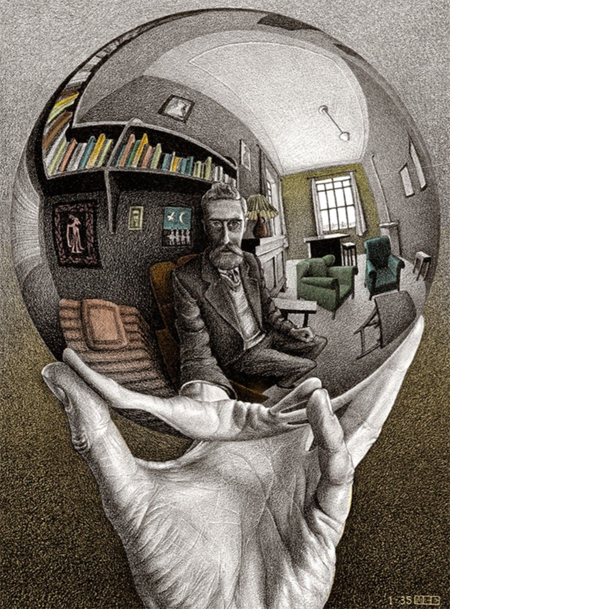
Iconoclasts: Kazu Hiro
Presented by Copro Gallery
KAZU HIRO is a contemporary hyperrealist sculptor living and working in Los Angeles. After working 25 years as a special effects makeup artist in Hollywood, Kazu decisively shifted focus in 2012, dedicating himself semi-full time to fine art sculpture.
Using resin, platinum silicone, and many other materials, Kazu constructs three-dimensional portraits in a scale two times life size. Kazu has received numerous accolades throughout his career including an Academy Awards Oscar in 2018 for his work in the film “Darkest Hour” helping good friend, actor, Gary Oldman to portray Winston Churchill.Kazu Hiro’s newest Hyperreal Portrait Sculpture will be unveiled at the LA Art Show in Copro Gallery’s booth. At the entrance to the show, Kazu is exhibiting a retrospective of several of his past works. There will also be an opportunity for collectors to take photos with each piece – Kazu will be present at scheduled times.
Kazu Hiro won an Oscar for Best Makeup and Hairstyling in Los Angeles over the weekend for his work on the film, Bombshell.
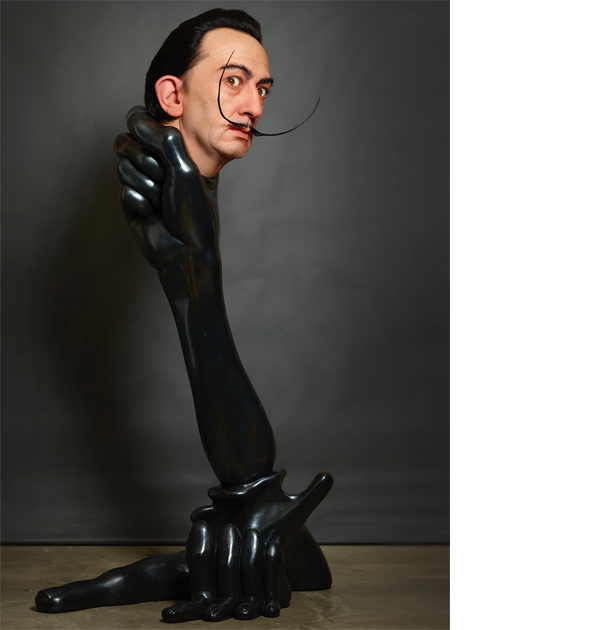
3.11 Requiem and Revival: Sogen Chiba
Presented by Gallery Kitai
Sogen Chiba’s 3.11 Requiem and Revival work transcribes newspaper reports of the Great East Japan Earthquake. Chiba created a new work in this series for the current exhibition. Given we are now seven years on from 3/11 our memories of the event are fading. We seek to record the memories of unimaginable disaster, and consider how we can move beyond them. Chiba himself is from the disaster-hit Ishinomaki district, and has used his indomitable spirit to move beyond misfortune and challenge himself to create works and imagery that can only be expressed in calligraphy.
Nine years have passed since The Great East Japan Earthquake and Related Disasters, and while recovery and revitalization continues in the disaster zones, there is also evidence of weathering in these areas. Amidst such circumstances, these works confront face on the question, what can only be expressed through contemporary calligraphy. Chiba himself is a survivor of the disaster, and incorporates strong messages for the people of the disaster zone in these works. His hope is that this exhibition will allow an even wider audience to see, know and feel these works. Chiba’s new work is included here. One direction being taken in avant-garde calligraphy, as seen in this work, is the shedding of the character nature of each character, making each viewer consider the definition of the work itself, is it calligraphy, is it not?
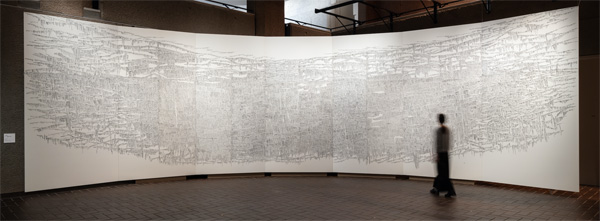
Taylor Camp: Edge of Paradise
Presented by John Wehrheim
In 1969, thirteen Hippies-refugees from campus riots, war protests and police brutality-fled to the remote Hawaiian island of Kauai. Before long this little tribe of men, women and children were arrested and sentenced to ninety days hard labor for having no money and no home. Island resident Howard Taylor, brother of actress Elizabeth, bailed out the group and invited them to camp on his vacant ocean front land-then left them on their own, without any restrictions, regulations or supervision. Soon waves of hippies, surfers and troubled Vietnam vets found their way to this clothing-optional, pot-friendly tree house village at the end of the road on the Island’s North Shore. In 1977, the government condemned the village to make way for a State park. Within a few years the jungle reclaimed Taylor Camp, leaving little but ashes and memories of “the best days of our lives.” John Wehrheim’s 1970s photographs reveal a community that created order without rules and rejected materialism for the healing power of nature.
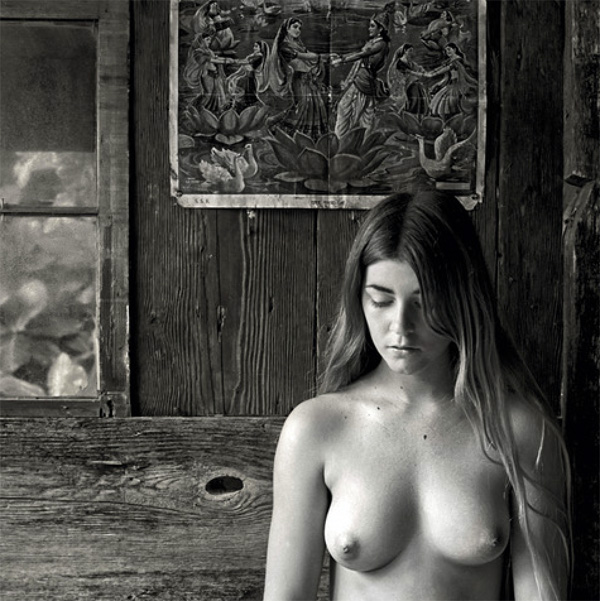
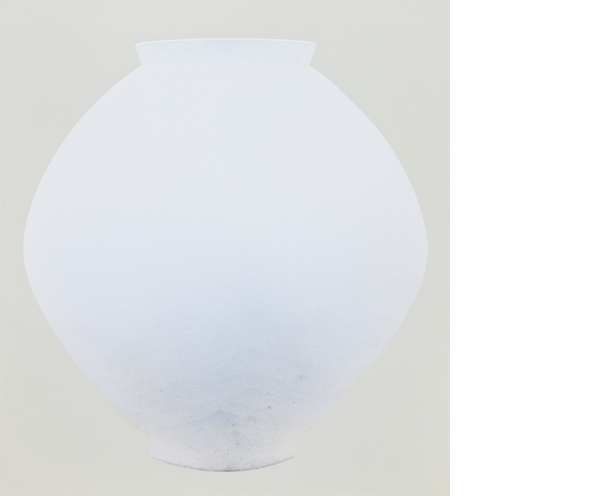
Karma: The Image of the Moon-Jar as the Epitome of Life: Choi Young Wook
Presented by SM Fine Art Gallery
Choi Young Wook has been painting the Chosun’s moon-jar for quite a number of years. The image of the moon-jar almost fills up the whole canvas, which at a glance, looks as if the painter executed it using a hyperrealistic technique. This is why some viewers or critics are quick to categorize his work as hyperrealism, but this interpretation is wrong. His work is not an objective representation of the image in a hyperrealistic style, but is rather, inclined to be subjective. The depiction of the image of the moon-jar is merely dressed in the style of figurative description. The only critical criterion that is summoned to interpreting his work as hyperrealistic is the reference to the description of the surface cracks on the pot, and this stems from the misunderstanding that the image of hairline cracks on the glazed porcelain surface represents the real fissure on the surface.
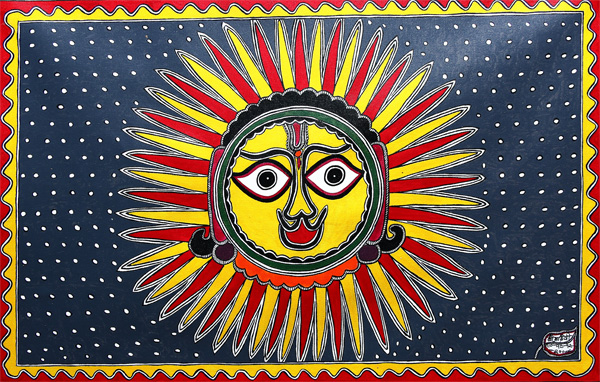
Of Aesthetics & The Vernacular: Baua Devi (Master Artist of Mithila Painting)
Presented by Arushi Arts / New Delhi / Los Angeles
This exhibition will showcase works by Baua Devi, a master artist of the Mithila or Madhubani style of painting in India. The Madhubani painting tradition played a key role in environmental conservation efforts in India in 2012, where there was frequent deforestation in the state of Bihar. Local trees were being cut down in the name of development. The main reason for the conservation effort was that the trees are traditionally adorned with the forms of gods and other religious and spiritual images. This recognition of the cultural and aesthetic significance of the trees saved them from being cut down. Madhubani paintings mostly depict people and their association with nature as well as scenes and deities from the ancient epics. Generally, no space is left empty; the gaps are filled by paintings of flowers, animals, birds, and even geometric designs.
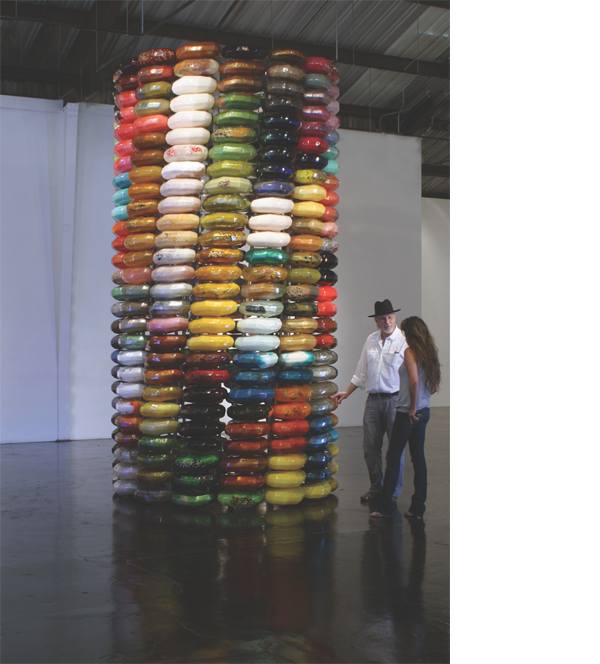
The Maize Project: Eric Johnson
Presented by Fabrik Projects
The “Maize Project” abstractly represents a lodge pole-like structure. In the Native American culture, the lodge pole is a gathering place and the title and shape of the sculpture reference a section of an ear of maize corn. For Johnson, this alludes to his Native American heritage and also is a call to raise awareness to issues of global hunger, alternative fuel, and corn’s complicated relationship to our food supply. The piece is assembled from more than 300 individually cast polyester resin units — “kernels”, as he calls them. The kernels were made in Johnson’s studio with various artists, friends and community members in assistance. The communal project took several years to complete. Participants were invited to select resin colors, sequencing of pours, and encase small objects or messages into the kernels. Customization ranges from the light hearted (candy corn) to the profound (baby teeth of a lost child).
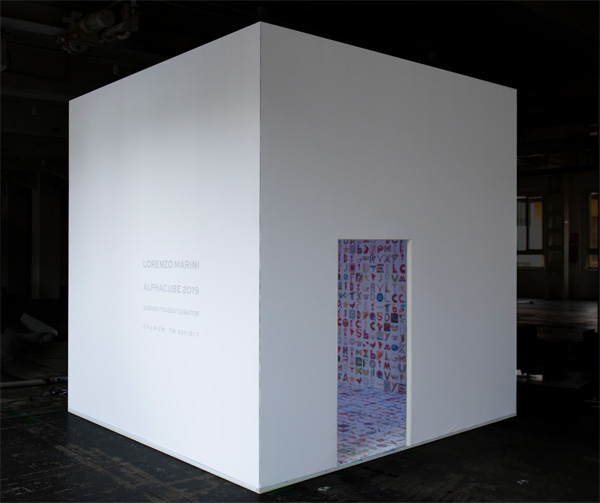
ALPHACUBE: Lorenzo Marini
Presented by Bruce Lurie Gallery
ALPHACUBE is the new art project from Lorenzo Marini curated by Sabino Maria Frassà. With ALPHACUBE, the artist literally upends the contemporary art paradigm of the white cube as the best form for conveying its use and comprehension. Lorenzo Marini turns that paradigm on its head and makes the “white cube” the housing, the outside of the artwork. The work is contained completely inside the cube, delineating a new, immersive space animated by artistic brilliance. ALPHACUBE rises in space like something alien, as much in form as in content: while it is obvious that the artist has a certain fascination for Dadaism and Futurism, which he reinterprets and actualizes, it also cannot be denied that the focus of the installation is not an aesthetic satisfaction but a social and cultural stimulus.
The formal result is therefore a fascinating and – we might as well admit it – extremely attractive and seductive installation, which literally hides “inside it” a criticism of how we communicate and interact today: too-much-information that sweeps away communication, for which language itself was born.
Happening: Ryan Schude
Presented by bG Gallery
A special exhibit booth of photographs by Ryan Schude. Schude is known for his large-scale, single-frame tableaux that are packed with sophisticated action – mingling surrealism and Americana with a touch of contemporary humor. In this latest body of work, Schude’s subjects intermingle with monumental exterior environments. Often viewed from a heightened perspective, forces of nature become part of each character’s open narrative.
Schude has been featured internationally and nationally in exhibits and publications including the cover of the Smithonian magazine’s Norman Rockwell edition. Recently he collaborated with Laura Miner on a Tableau Vivant for the San Francisco Museum of Modern Art which highlighted the employees and their artwork created outside the museum as the subjects of the narrative. This project is part of a larger series involving photographs of individuals in institutions as a documentation of a ‘Happening’ in the photographic process.
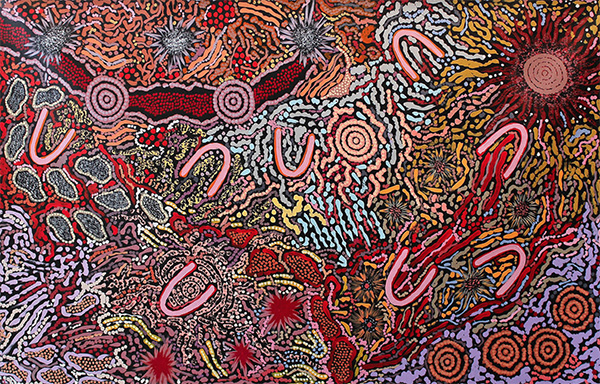
Grandmother’s Country: Gabriella Possum Nungurrayi
Presented by Australian Aboriginal Art Gallery
Women are the principle gatherers of Bush Tucker and it is an important part of everyday life within the family clan. This particular painting, Grandmother’s Country, depicts women collecting food and also celebrates the fertility of the land. Aboriginal paintings are based on the myths of the Dreamtime. In modern dot representations, the sacred aspect of the painting is not always revealed, but the meaning remains, transmitted through symbols that are easily understood.
Each person has a particular Dreaming to which they belong and they have special ceremonial dances and songs that combine together to form a unique belief that makes up the lives of the Aboriginal people. All things relate to the land and thus the land is of great importance to them. The land is the keeper of the Dreaming and must be kept safe for all time so that the Dreaming stories, which are told in the paintings, can be preserved. Gabriella Possum Nungarrayi is one of Australia’s premier female Aboriginal artists from the Central Desert who is currently working in Melbourne. At an early age, Gabriella began painting alongside her father the renowned, Clifford Possum Tjapaltjarri, whose works are represented in major galleries and private collections worldwide. He passed on his skills to his daughter, whose paintings reflect his unique style.
Gabriella Possum Nungarrayi is one of Australia’s premier female Aboriginal artists from the Central Desert who is currently working in Melbourne. At an early age, Gabriella began painting alongside her father the renowned, Clifford Possum Tjapaltjarri, whose works are represented in major galleries and private collections worldwide. He passed on his skills to his daughter, whose paintings reflect his unique style.
Gabriella’s artistic skill was first rewarded in 1983 when she gained an award in the prestigious Alice Springs Prize while still a student at Yirara College. Her work has been praised as being “innovative” and “culturally significant”. Gabriella uses modern materials (acrylic paints on canvas) to create traditional designs. Her colours are inspired by the dramatic contrast in colour of the Central Desert landscape. Gabriella’s Dreamings include Women’s Ceremonies, Goanna Dreaming and the Seven Sisters Milky Way Dreamings which have been handed down through generations of ancestors. Her work is represented in the National Gallery of Australia (Canberra) and the Museum and Art Gallery of the Northern Territory.
Some of her most famous work has included the 2008 Chelsea Garden Show. the design of the Art Tram during the 2014 Festival of Melbourne, and the design of the Opera House for the 2016 Vivid Festival in Sydney.
Chinese Contemporary Ink Art: Ten Leading Artists
Presented by Michael Goedhuis
Michael Goedhuis will be exhibiting the ten best contemporary ink painters from China.
The exhibition will describe, through the works of these ten leading artists, how Chinese contemporary culture is being transformed via a profound understanding of Chinese historical civilization. Gu Wenda, Li Huayi, Li Xubai, Liu Dan, Lo Ch’ing, Qin Feng, Qiu Deshu, Tai Xiangzhou, Wang Dongling and Wei Ligang are creating a new pictorial language which expresses the fundamentals of Chinese aesthetics and culture in ways which are relevant to today’s society in China and also to the developments in the West.
Ink paintings emerged 1000 years ago from calligraphy: the sublime and central achievement of China. Calligraphy is executed in ink on silk or paper, with a brush. In order to master this brush on the absorbent paper, which tolerates no error or correction, the artist has to achieve a high degree of concentration, balance and control. Painting is an extension of the art of calligraphy. It is therefore, like calligraphy, linked to the sacred prestige of the written word.
It has been almost impossible until recently for westerners to grasp the significance of calligraphy for the Chinese. It has been the foundation-stone of their society since the dawn of civilization. It is the most elite of all arts…practiced by emperors, aesthetes, monks and poets throughout history but also ostentatiously alive today in advertisements, cinema posters, restaurants, tea-houses, railway stations, temples and on rough peasant village doors and walls.
Ink painting was practiced by the scholar gentleman for whom the prime purpose is the cultivation of an inner life, the ultimate aim of which is to perfect one’s character in order to attain the moral stature befitting one’s status as a gentleman.
Contemporary Literati Art: Ink Art
The successors of the gentleman-scholars described above are today’s ink artists. They are deeply aware of the classical canon and its aesthetic and moral imperatives and have carefully studied the old masters. However, just as Picasso and Cezanne studied Raphael, Poussin, Velasquez and others in order to create THEIR revolutionary pictorial language, so the new literati are doing the same in order to formulate their own revolution for their work to be relevant to, and meaningful for, the world of today. And revolutionary and culturally subversive it is. More subtle than the contemporary oil painters with their abrasive handling of overtly political themes, the ink painters embody their revolutionary message in works that are not afraid to take account of the past in order to make sense of the present.
Very many different stylistic approaches have therefore evolved over the past 30 years. Works now range from those that at first sight look quite traditional but in fact embody powerful fresh aesthetic initiatives by artists like Liu Dan, Li Xubai, Li Huayi, Yang Yanping, to those that are unambiguously avant-garde seen in the works of Qiu Deshu, Wei Ligang, Yao Jui-chung, Lo Ch’ing, Wang Dongling and Gu Wenda.
It is therefore probable that these few (only 50 or so of international stature) artists are poised to assume a historic relevance as the cultural conduit between China’s great past and her future. And as such they are likely to shortly become the target of the new generation of collectors and museums in China and the diaspora who, in their newfound national pride and following the global fashion that only contemporary is cool, will be hungry for contemporary manifestations of their country’s enduring civilization.
Michael Goedhuis, who was the first dealer in the west to recognize the significance of these radical innovations in Chinese culture, has concentrated on identifying the artists who are in the process of shifting the axis of Chinese aesthetics.
In 2008, he assembled and curated the major contemporary Chinese Art collection, the Estella collection, which was exhibited at the Louisiana Museum of Modern Art, Copenhagen and the Israel Museum in Jerusalem. Most of his activity since then has been directed at describing both the resurgence of cultural activity in the China of today and the key relevance of Chinese Ink art to contemporary aesthetics.
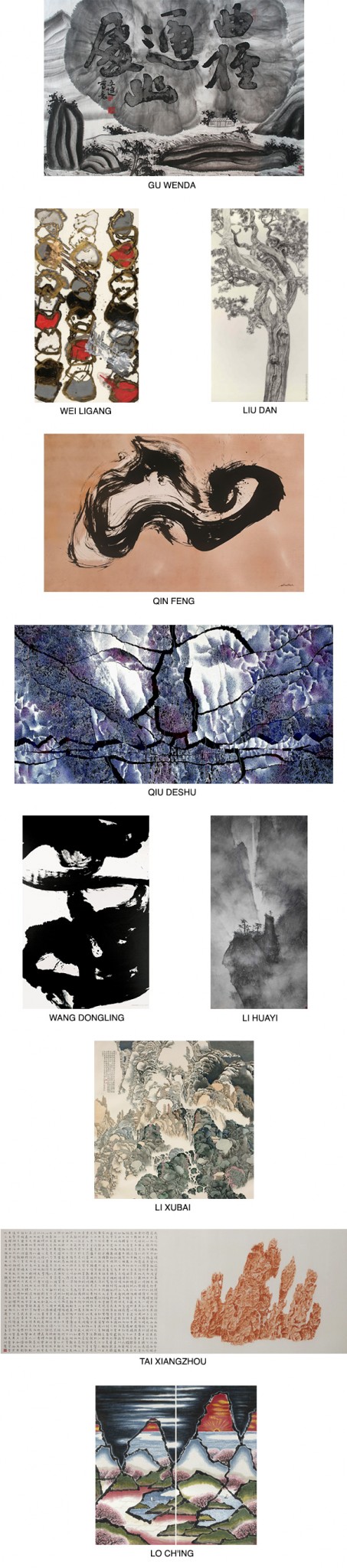
Shark: RISK
Presented by 5Art Gallery
Beloved LA graffiti artist RISK makes his LA Art Show debut with two sculptures from his ongoing “Shark” series that has evolved to explore predators in their many forms. One of the most talked about sculptures of 2018 was his bisected police cruiser, an actual cop car dipped in formaldehyde and sliced open “like bacon,” revealing the vehicle’s inner workings. For the show, this controversial piece will be juxtaposed with a similar sculpture of a shark comprised of spare machine parts. Inspired by Damien Hirst’s “Natural History,” the pairing is a commentary on how police “patrol the hood like sharks.” “Embrace what you fear” is an idea that stems from Buddhist teachings and RISK’s bisected cop car was the surprise outcome of a meditation on this principle.
The project actually began as a sculpture of a shark and metamorphosed into a different kind of predator, complete with its own version of telltale fins, shape and color palette. Across from it will be the finished sculpture of the shark he originally intended to create – a predator from a different era that still strikes just as much fear.
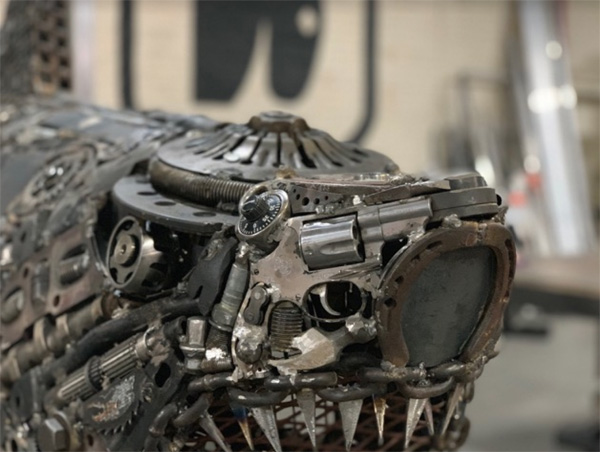
Black Landscape: Chuni Park
Presented by Baik Art
Inspired by natural landscapes, Chuni Park recreates abstract paintings from memory of the places he’s explored and populates them with a cast of symbolic, often recurring characters.
Featured will be Park’s large-scale, multi-panel installation, Black Landscape, which draws the seasons in black ink derived from pine soot.
In the months leading up to the LA Art Show, Park is also traveling through California and the American West, visiting national parks like Yosemite for inspiration. He will be premiering several new pieces inspired by his exploration of the Southwest, joining iconic landscape artists like Hockney who have tackled similar subject matter. This will be Park’s first time depicting American landscapes – opening a whole new world for his work and starting a new chapter in his creative career.
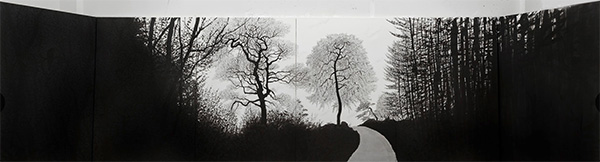
The Best Days of your Life, an Atlas: Scott Hove
Presented by Art All Ways
Scott Hove returns to LA Art Show this year with this museum-scale wall installation, “The Best Days of Your Life, an Atlas”. Formerly known for the first large scale archway at Littletopia, and then for his widely acclaimed cake-themed mirror infinity chamber, Hove is presenting a more detailed and crafted wall piece that will illuminate minds and the immediate space.
For this sculpture, he has used a more painterly approach to composition, and has applied multiple illumination points to provide a sense of radiant heat and fantastical texture to engage viewers in a very active way. The 36 gallons of acrylic “frosting” create a compelling illusion of imminent satisfaction, and a re-imagined and idealized contextualization of personal memory. For much of Hove’s work, artifice serves as a medium to support a fantasy narrative that can seem at once safe and inviting, and then questionable and menacing.
Scott currently lives and works in Los Angeles.
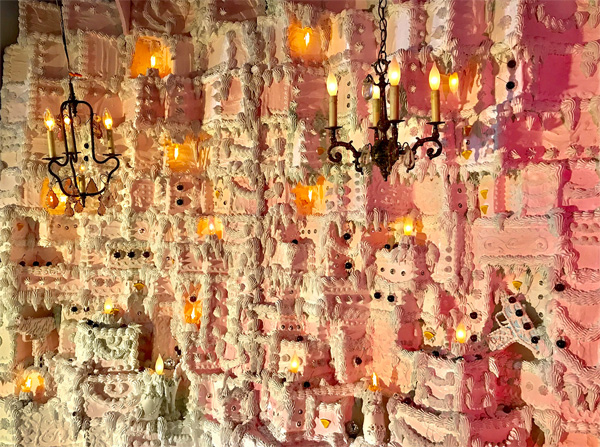
Dansaekhwa IV: Internal Rhythm – Kim Tae-Ho
Curated by Simon Kwon
Presented by SM Fine Art Gallery
Development of Kim Tae-Ho’s most recent works coincided with the turning of the millennium, about the year 2000. Focusing on brush strokes and the application of color, for the most part, these works appear to be vastly different from his previous works.
Above all, concerning the changing of appearance, thick layers of paint form bulky masses, which clearly diverge from his previous two-dimensional illusionary pieces. Simultaneously there are differences in physicality, and they differ uniquely from the full compositions of his paper works. Regarding the process, he first draws interwoven lines. He creates a fixed rhythm, and after building up twenty layers of paint, he then scrapes away the dense accumulation of paint. Color that is hidden beneath rhythmically comes alive within the structure. Countless visual spaces are constructed within the overlapping grid formation; each cell is comparable to a beehive, producing its own life in the realm of painting.
The concept of Kim’s work is both constructing and de-constructing. The repeated grid formation acts as the framework of determined thickness, yet there are densely massed circular forms within the structure. He states: “the process of eliminating emphasizes the structure”; his method of scraping and carving away meticulously laid out paint is paradoxical because numerous layers of color are built up. Partial scraping brings buried colors back to life. The contrast between breathing colors within the solid outer structure creates a mysterious sense of life. The representative duality that originates from his early period has been transferred and transformed. After examining these works, we see that they reveal his method to be more meaningful because of his method of representation.
Kim has also made his process include the painting of the basic background color; this reveals his meticulous approach. The method of applying twenty different layers of paint in itself is painstaking labor.
Furthermore, work is added through the process of scraping and refining. Evidently, it is just as difficult to create the layers of paint as scraping them away. The process would be futile if subtle rhythm were not created through the process of scraping paint away or the addition of mysterious shimmer in the process of making color. Moreover, the expression would appear boring, were it not for the densely drawn small rooms harmonizing like a choir.
Finally, the artist’s interior psyche adds the finishing touch through a living rhythm. Without this, the works would be no more than simple masses. Japanese art critic Zibashikeo remarks that Kim “is a painter who attains something from beyond the two-dimensional surface of the material,” but what is that “something”? Perhaps he foresees a process that surpasses those that operate on what is visual. Since “aspects of texture and vision, time and space become integrated before dispersing again to form new meanings,” Kim deviates from the common grammar of paint making; his recent works are a fundamental challenge to painting itself as we consider whether limits can exist in painting.
Cristobal Valecillos // YARE: One More Dance
Presented by Timothy Yarger Fine Art
Yare, One More Dance is a contemporary multi-disciplinary representation of Los diablos de Yare – declared an Intangible Cultural Heritage of Humanity by UNESCO.
To celebrate the Getty’s Pacific Standard Time: LA/LA initiative, the artist invokes the annual
Los Diablos de Yare festival by creating a collection of handcrafted masks. Valecillos created a series of stunning photographs set against a backdrop of iconic Los Angeles landmarks. These provocative and compelling images incorporate the joys and challenges of the contemporary human spirit.
The Dogma that enables our darkest times, the Propaganda that seduces us into complicity, the Basura that feeds us, the Matasano to whom we trust our greatest love, the Solo our technological refuge, “El Dulce”, leader of the gang that ridicules our thirst, the Asfixia we are inflicting upon Mother Earth and the Sangre that we so irresponsibly shed.
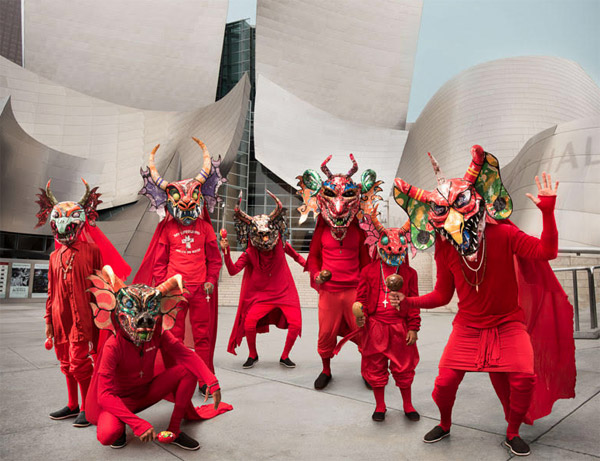
Director’s Chair: Matthew Modine
Presented by Axiom Contemporary Gallery
On the 30th anniversary of Stanley Kubrick’s Full Metal Jacket, Matthew Modine’s “Full Metal Diary” offers an incredibly rare and vibrant portrait of one of cinema’s most iconic war films – by one of the industry’s most enigmatic directors. The exhibition is a study of a young actor under the apprenticeship of a legend.
A combination of rarely seen, medium-format photographs taken on set are displayed alongside poetic, intimate excerpts from the actor’s personal diary. This glance behind-the-curtain reveals unique insights into Kubrick’s methodology as well as the complicated process of an actor struggling to come to terms with his craft. “Full Metal Diary” is an extraordinary example of art imitating life.
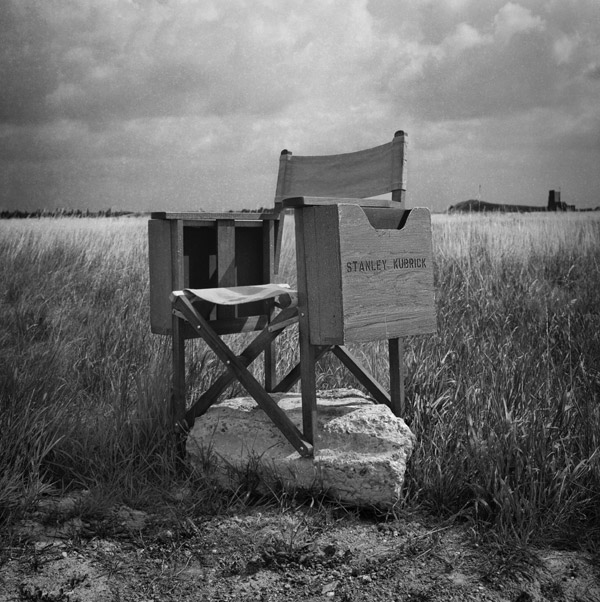
Through The Looking Glass – Harmonia Rosales and Aldis Hodge
Presented by Simard Bilodeau Contemporary
Through The Looking Glass was birthed from the notion of introspective cultural perception. It questions the viewer’s engagement with cultures not recognized as his or her own, as well as the educational conduits to said cultures, and finally, it questions the viewer’s responsibility to pursue these inquiries.
Created in the spirit of social experimentation, Through The Looking Glass aims for the audience to engage in an internal conversation, allowing themselves to reveal their innermost workings.
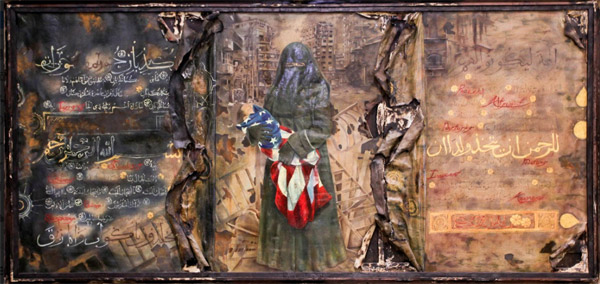
Cartoon-folding screen LED TV: Lee Nam Lee
Presented by Simyo Gallery
A traditional Asian five-folding screen is reproduced in digital form where the still images of the classical masterpieces come alive as they travel through time. The interaction between the cartoon characters and the various images iconic of art, war, and our society speaks of the many faces of modern civilization. Moreover, a sense of healing and restoration is offered through the seasonal transformation of the landscape in the classical paintings.
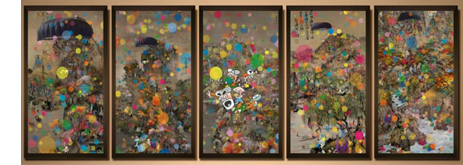
Pandemonia
Curated by Hoojung Lee
Presented by Art All Ways
Created by an anonymous London artist, Pandemonia is a multi-media conceptual Art project centred around a female character constructed from symbols and archetypes. Her plastic exterior takes the form of a three-dimensional drawing halfway between the real and the imagined.
In her special performance, Pandemonia will pose and perform with various objects & eye candy from her perfectly ideal, surreal world. The objects will comprise Trompe l’oeil commodities, handbags, pets, vacuum cleaners, irons, household objects & personal belongings like jewelry, glasses – all echoing her Pop Feminist vocabulary. She will be in costume, characterized by phenomenal hair pieces and dresses made of latex.
Pandemonia will engage the public, and entice art show visitors to interact with her, to participate and create their own unique art work captured as a Polaroid selfie.
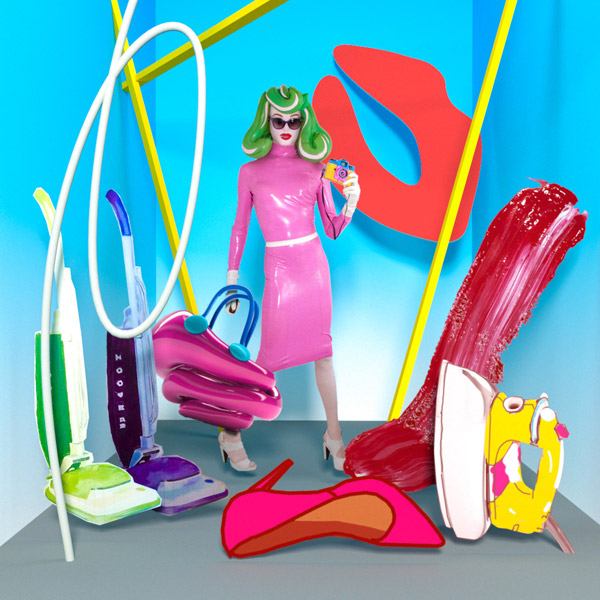
I’m Not A Trophy: Arno Elias
Presented by Denis Bloch Fine Art
Established in 2016, I’m Not A Trophy is a global initiative to create greater awareness in the malicious acts of trophy hunting and poaching of endangered species. Founded by French artist Arno Elias, the campaign utilizes powerful females figures, like internationally celebrated supermodel and actress, Cara Delevingne, to represent the program’s commitment to bringing increased attention to trophy hunting while empowering women to fight back against sexist stereotypes.
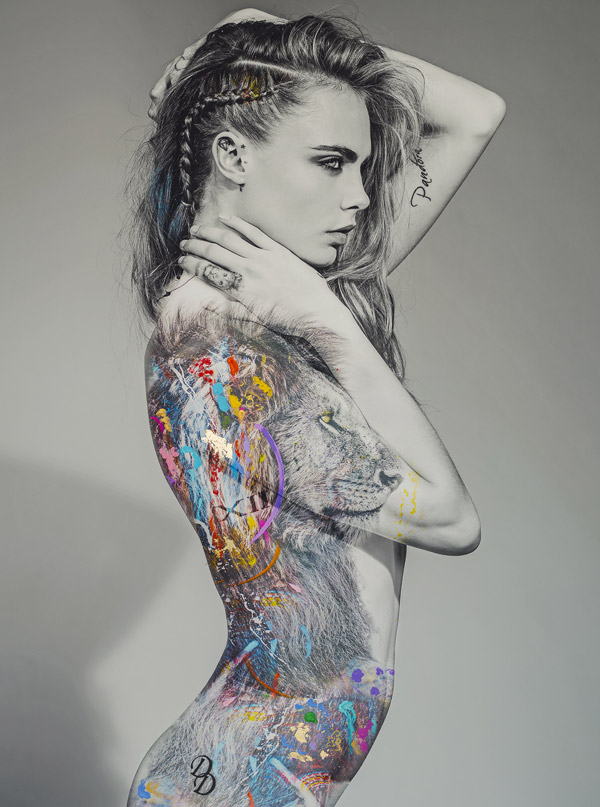
Connect the Dots: Logan Maxwell Hagege
Curated by Beau Alexander
Presented by Maxwell Alexander Gallery
Contemporary American Artist, Logan Maxwell Hagege, in collaboration with Maxwell Alexander Gallery, is proud to present Connect the Dots. An installation that brings us back to our childhood and turns us all into artists. Each attendee will have five minutes to connect the dots and reveal an original work of art. Connect the Dots with us and take home a free piece of art with the modern vision of Hagege’s Western landscapes.
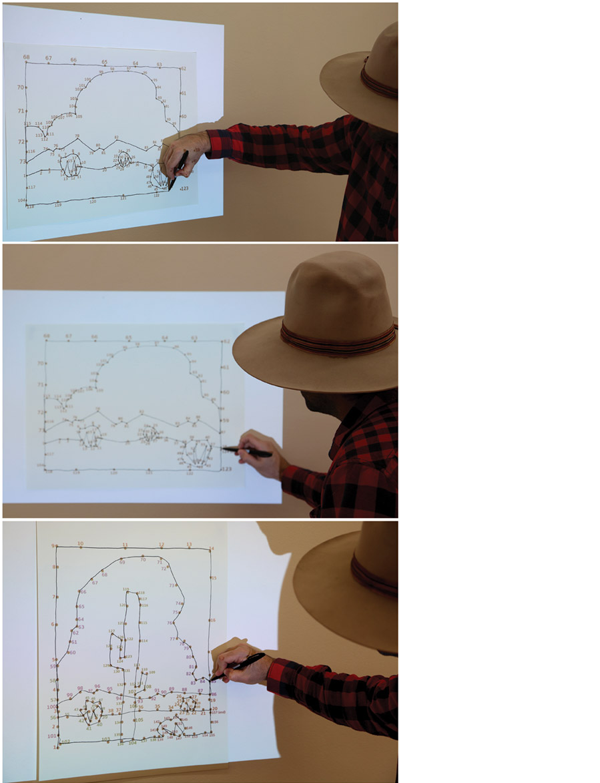
Girasoles: Claudio Castillo
Presented by Blink Group
Claudio Castillo’s “Girasoles” is a generative clock that plays 24 one minute animations at the top of each hour, and also tracks the moon and tidal phases in real time. The images endlessly evolve in a random progression in which no single composition will ever be precisely repeated, at least not for thousands of years.
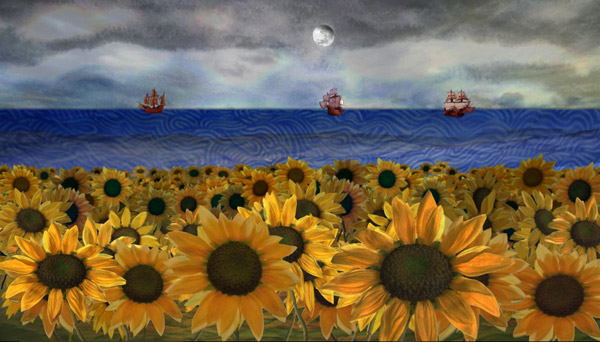
Reconstructing Memory Portraits: Mike Saijo
Presented by bG Gallery
This workshop explores the effects of current and recent cultural and technological changes in the media on shaping the self. Mike Saijo will take a photograph of each participant, which he will then print directly onto a section of newspaper chosen by the participant. The guest has the option to take the portrait home with them. The booth will feature large scale portraits of influencers in current technological and cultural shifts.
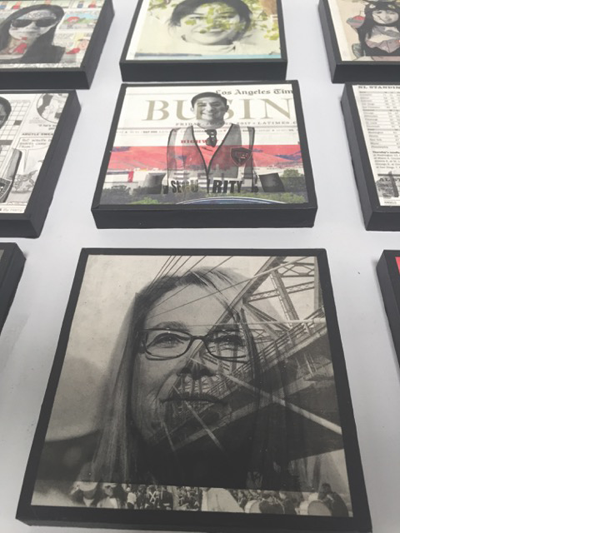
The Infinity Boxes: Matt Elson
Presented by: bG Gallery
Artist Matt Elson presents a series of boxes that allow intimate groups of people to interact via elaborately constructed infinity mirrors set up inside.. Aesthetically they are objects that draw the viewer in from a distance with the box’s odd beauty and become progressively less comprehensible during interaction.
Typically two people will walk up, look in from each side, put their heads in the box, and then are surprised by the world that opens up inside. The works truly become active only when someone else is looking in the box from the other direction creating a social connection in a perceptually-created other world.
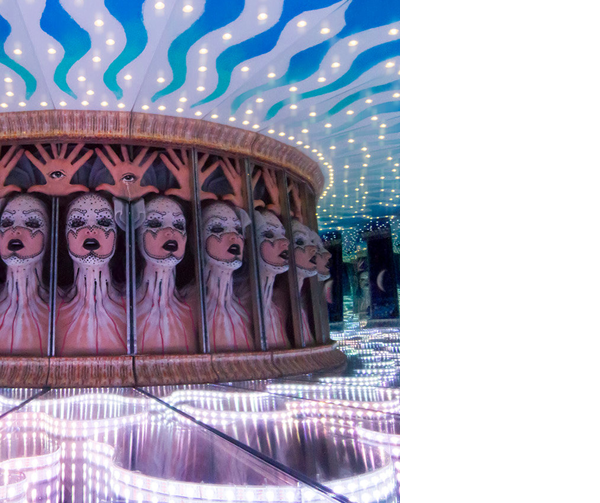
Songs and Poems II: Erika Harrsch
Curated by Gabriela Rosso
Presented by Rofa Projects, Maryland
Harrsh’s work, thematically aligned with the butterfly, share content based on migration and the surrounding circumstances that define identity, nationality and global mobility. Departing from these projects, she has further elaborated on the complexity of the migratory experience, to approach immigration reforms and the recontextualization of the physical borders.
Erika creates wall installations with cut-out butterflies incorporating images of international currency.
The circular patterns and waves created by currency butterflies and drawings represent the countries from which people are moving, reflecting on how these mass influxes shape economic markets.
After hearing Philip Glass’s metamorphosis in a concert, Harrsch got inspired and was commissioned to illustrate the CD of this great composer.
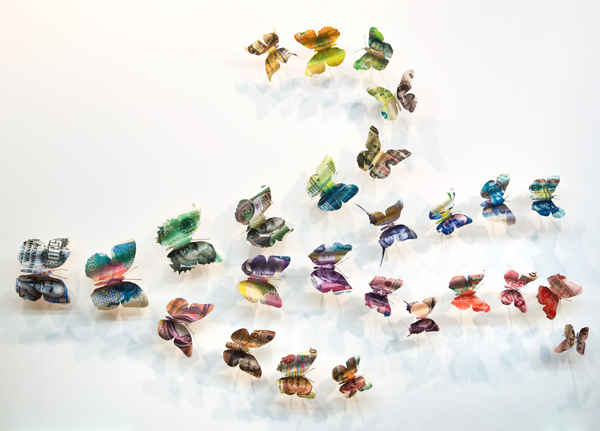
SABER: Painting Live
Presented by 1849 Wine Company
SABER, also known as Ryan Weston Shook, is an American fine artist who originated as a graffiti artist. Described as one of “the best and most respected artists in his field” by the Washington Post, SABER joins the the LA Art Show on Opening Night to create an original work which will be on display throughout the run of the show.
Rising to international fame at the age of 21, SABER created the world’s largest graffiti piece on the bank of the LA River, which was visible and documented by satellites in space. Over years of dedicated and often dangerous painting, he helped bring public awareness to the true art form of graffiti. His work has influenced a generation of artists and graphic designers, and has become an influential part of modern entertainment, social media, and art for social reform. He continues to make his vibrant, mesmerizing and often political paintings from his home in Los Angeles. His art can be found in galleries and private collections around the world. Meanwhile, he continues to create public conversation about, and push the boundaries of, what art should (or shouldn’t) be confined to.
1849 Wine Company’s inspiration for its wines stems from the urban art movement of the 21st century. The fascinating power of art lies in an artist’s power to disrupt norms, transcend taboos and change our perspective. Every handcrafted bottle of 1849 wine reflects this artistic spirit and the dedication to the art of wine making, and Saber’s blaze of colorful, expressive and captivating pieces are the artistic representation of 1849 Wine Company branded wines, adorning each bottle.
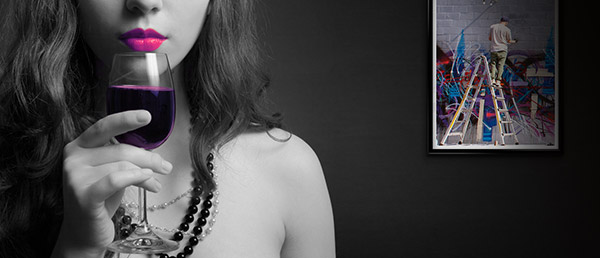
Jung-Gi Kim’s Drawing World
Presented by Korean Manhwa Contents Agency
Jung-Gi Kim is a Korean drawing artist as well as comic artist. There is nothing in the world he cannot draw. Everything he has experienced or never experienced can be depicted by him perfectly.
His teacher is nature itself. His work can be explained only by the laws of nature. The subjects of his drawing are as infinite as the universe that resulted from the big bang.
His world has been perfect since his teens, and he persists in his efforts to maintain it – he is always creating with his hand, evolving constantly.
His work is realistic – and even unrealistic subjects look very realistic. We are persuaded by his explanation wordlessly, his lines breaking free. This can be viewed as the perfect ‘drawing’ that everyone can imagine and dream.
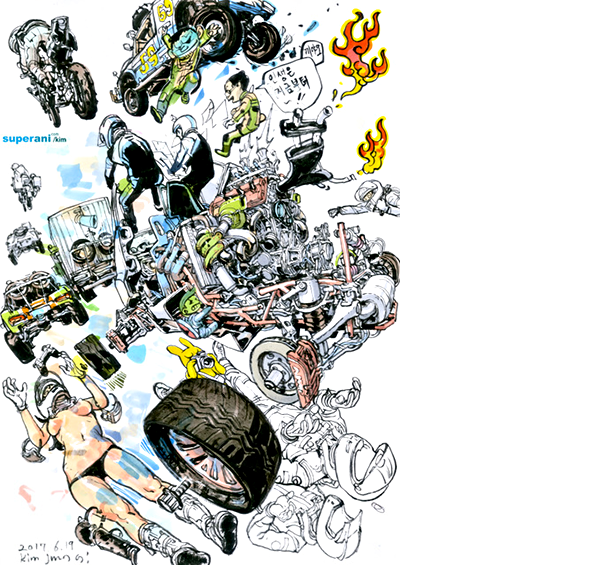
L.A.: Ley Lines
Curated by Alex “Axis”Ventura
Presented by Cartwheel Art
Alex “Defer” Kizu | David “Big Sleeps” Cavazos | Raymundo “Eyeone” Reynoso
Jose “Prime” Reza | Paul “Swank” Nandee | Alex “Axis” Ventura
Artists from different communities around Los Angeles have been carefully selected to showcase the very distinct aesthetics of the areas each individual artist personifies. Having deep roots in the early Los Angeles graffiti movement, these artists also have backgrounds in California staples, such as skateboarding, punk rock, gangs, tattooing and various other disciplines that are vital to L.A.’s rich artistic culture and history. They’ve established themselves in the raw environment of the L.A. streetscape and in recent years have moved into some of the most prestigious galleries and museums in the world.
Experience the works of these artists that have emerged from the incessant hardships of the Los Angeles streets, elegantly displayed as if the viewer were welcomed into the home of a private collector in a classic turn of the century setting.
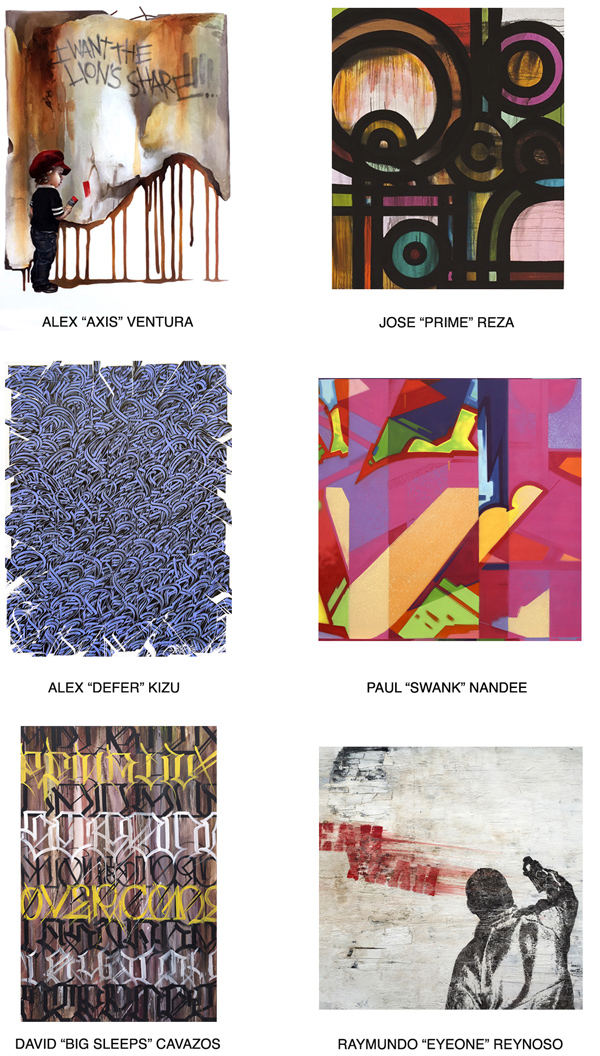
2026 Partners